
- Posts: 7923
- Thank you received: 70
Obama’s moocher culture
- otisptoadwater
-
 Topic Author
- Mountain Legend
-

Less
More
19 Sep 2012 19:34 #1
by otisptoadwater
I can explain it to you but I can't understand it for you.
"Any man who thinks he can be happy and prosperous by letting the Government take care of him; better take a closer look at the American Indian." - Henry Ford
Corruptissima re publica plurimae leges; When the Republic is at its most corrupt the laws are most numerous. - Publius Cornelius Tacitus
Obama’s moocher culture was created by otisptoadwater
[center:1j0a0uaz]http://danieljmitchell.files.wordpress.com/2012/05/julia-moocher.jpg?w=500[/center:1j0a0uaz]
By THE WASHINGTON TIMES The Washington Times Tuesday, September 18, 2012
The liberal media went wild over a video of Mitt Romney saying people who pay no taxes and live off government handouts have no reason to vote for him. Left unsaid is that Barack Obama has been running on exactly that platform. When it comes to the culture of dependency, President Obama built that.
Mr. Obama views government as a bottomless well of free handouts. Every idea, every proposal, every promise Mr. Obama makes involves the government giving something to somebody. His urgent focus is to expand and strengthen government’s role in everyone’s daily life. This was illustrated in the Obama campaign slideshow “The Life of Julia,” a detailed roadmap for cradle-to-grave dependence on government. Every slide began with, “Under President Obama” — which the White House believes is the proper place for Americans.
Read more: http://www.washingtontimes.com/news/2012/sep/18/obamas-moocher-culture/#ixzz26y9esaDa
By THE WASHINGTON TIMES The Washington Times Tuesday, September 18, 2012
The liberal media went wild over a video of Mitt Romney saying people who pay no taxes and live off government handouts have no reason to vote for him. Left unsaid is that Barack Obama has been running on exactly that platform. When it comes to the culture of dependency, President Obama built that.
Mr. Obama views government as a bottomless well of free handouts. Every idea, every proposal, every promise Mr. Obama makes involves the government giving something to somebody. His urgent focus is to expand and strengthen government’s role in everyone’s daily life. This was illustrated in the Obama campaign slideshow “The Life of Julia,” a detailed roadmap for cradle-to-grave dependence on government. Every slide began with, “Under President Obama” — which the White House believes is the proper place for Americans.
Read more: http://www.washingtontimes.com/news/2012/sep/18/obamas-moocher-culture/#ixzz26y9esaDa
I can explain it to you but I can't understand it for you.
"Any man who thinks he can be happy and prosperous by letting the Government take care of him; better take a closer look at the American Indian." - Henry Ford
Corruptissima re publica plurimae leges; When the Republic is at its most corrupt the laws are most numerous. - Publius Cornelius Tacitus
Please Log in or Create an account to join the conversation.
- Rick
-

- Mountain Legend
-
Less
More
- Posts: 15708
- Thank you received: 165
20 Sep 2012 08:25 #2
by Rick
The left is angry because they are now being judged by the content of their character and not by the color of their skin.
Replied by Rick on topic Obama’s moocher culture
Obama has more than enough money to live an easy life. He should give away a large chunk of his wealth so he can prove to his followers that he puts his money where his mouth is. He would rather use other peoples money for his charitable giving.
The left is angry because they are now being judged by the content of their character and not by the color of their skin.
Please Log in or Create an account to join the conversation.
- Wily Fox aka Angela
-

- Mountain Legend
-
Less
More
- Posts: 2005
- Thank you received: 16
20 Sep 2012 09:09 #3
by Wily Fox aka Angela
Replied by Wily Fox aka Angela on topic Obama’s moocher culture
The "moochers" include everyone on Medicare and Social Security as well. So much for the older vote now, too. Then you have those that work but make so little, they may receive some sort of assistance for food or shelter.
Interestingly enough, here is a breakdown by state on the least amount of federal taxes paid in 2011
Since Romney sees the 53 percent of Americans who are net federal taxpayers as his natural constituency, you expect him to be doing especially well in the states where they live.
That doesn’t seem to be the case. Via @emsimpson, here is a map of federal income tax non-payment rates by state compiled by the Tax Foundation:
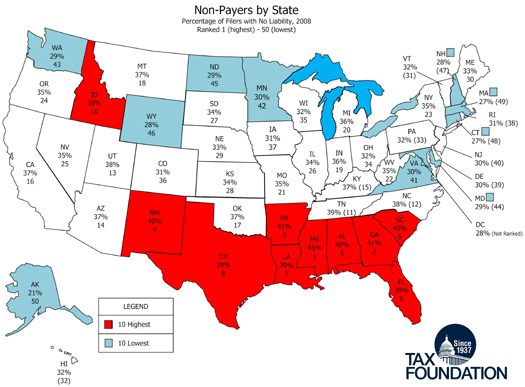
Interestingly enough, here is a breakdown by state on the least amount of federal taxes paid in 2011
Since Romney sees the 53 percent of Americans who are net federal taxpayers as his natural constituency, you expect him to be doing especially well in the states where they live.
That doesn’t seem to be the case. Via @emsimpson, here is a map of federal income tax non-payment rates by state compiled by the Tax Foundation:
Please Log in or Create an account to join the conversation.
- LadyJazzer
-

- Mountain Legend
-
Less
More
- Posts: 14880
- Thank you received: 27
20 Sep 2012 09:14 #4
by LadyJazzer
Replied by LadyJazzer on topic Obama’s moocher culture
I know he doesn't like to be confused with FACTS, but here is how it breaks down:
I just love GOTP desperation... I could sit and watch it for hours...
http://www.washingtonpost.com/blogs/ezr ... s/?hpid=z3For what it’s worth, this division of “makers” and “takers” isn’t true. Among the Americans who paid no federal income taxes in 2011, 61 percent paid payroll taxes — which means they have jobs and, when you account for both sides of the payroll tax, they paid 15.3 percent of their income in taxes, which is higher than the 13.9 percent that Romney paid. Another 22 percent were elderly.
So 83 percent of those not paying federal income taxes are either working and paying payroll taxes or they’re elderly and Romney is promising to protect their benefits because they’ve earned them. The remainder, by and large, aren’t paying federal income or payroll taxes because they’re unemployed. But that’s a small fraction of the country.
Behind this argument, however, is a very clever policy two-step that’s less about who pays taxes now and more about who is going to pay to reduce the deficit in the coming years. Here’s how it works.
Part of the reason so many Americans don’t pay federal income taxes is that Republicans have passed a series of very large tax cuts that wiped out the income-tax liability for many Americans. That’s why, when you look at graphs of the percent of Americans who don’t pay income taxes, you see huge jumps after Ronald Reagan’s 1986 tax reform and George W. Bush’s 2001 and 2003 tax cuts. So whenever you hear that half of Americans don’t pay federal income taxes, remember: Ronald Reagan and George W. Bush helped build that. (You also see a jump after the financial crisis begins in 2008, but we can expect that to be mostly temporary.)
Some of those tax cuts for the poor were there to make the tax cuts for the rich more politically palatable.

I just love GOTP desperation... I could sit and watch it for hours...
Please Log in or Create an account to join the conversation.
- FredHayek
-
- Mountain Legend
-
Less
More
- Posts: 31360
- Thank you received: 181
20 Sep 2012 09:18 #5
by FredHayek
Thomas Sowell: There are no solutions, just trade-offs.
Replied by FredHayek on topic Obama’s moocher culture
Obama increased debt from 10 trillion to 16 trillion on his watch, more than a trillion a year. Part of this is because tax receipts are down because the economy continues to stagnate at 1% growth. But the spending has risen to record levels that are unsustainable. How does Barack plan to correct this? Raise taxes to 35% for 1% of the population?
Thomas Sowell: There are no solutions, just trade-offs.
Please Log in or Create an account to join the conversation.
- LadyJazzer
-
- Mountain Legend
-
Less
More
- Posts: 14880
- Thank you received: 27
20 Sep 2012 09:23 #6
by LadyJazzer
Replied by LadyJazzer on topic Obama’s moocher culture
A lousy 4.6% on ONLY THAT INCOME ABOVE $250,000 is a start... (Pelosi offered them a $1-million break to see if they would take it--knowing that they wouldn't--and when they did what was expected, and turned it down, she pulled it off the table...)
Yeah... It's a start... Get rid of the $4-Billion/year hand-out to the oil companies, who are making the highest profits in history WITHOUT IT, (and doing so on the back of the US consumers); cut the flow at the trough where the defense-contractors feed... Close loopholes and aggressively go after the clowns that hide their millions off-shore... It adds up...
Yeah... It's a start... Get rid of the $4-Billion/year hand-out to the oil companies, who are making the highest profits in history WITHOUT IT, (and doing so on the back of the US consumers); cut the flow at the trough where the defense-contractors feed... Close loopholes and aggressively go after the clowns that hide their millions off-shore... It adds up...
Please Log in or Create an account to join the conversation.
- FredHayek
-
- Mountain Legend
-
Less
More
- Posts: 31360
- Thank you received: 181
20 Sep 2012 09:53 #7
by FredHayek
Thomas Sowell: There are no solutions, just trade-offs.
Replied by FredHayek on topic Obama’s moocher culture
After four years, all Obama has is a "start" that won't pass. Obama term, a term in a holding pattern. No passed budgets and sequesteration.
Thomas Sowell: There are no solutions, just trade-offs.
Please Log in or Create an account to join the conversation.
- Wily Fox aka Angela
-
- Mountain Legend
-
Less
More
- Posts: 2005
- Thank you received: 16
20 Sep 2012 09:57 #8
by Wily Fox aka Angela
Replied by Wily Fox aka Angela on topic Obama’s moocher culture
part of the reason the debt side of the equation got higher is that Obama is accounting for the wars and Medicare prescription act that Bush was not. I think it was all part of the transparency plot to get real on the costs of running the wars, etc.
The real problem is the do nothing members of Congress and Senate that has made it clear that they would not help Obama succeed at anything in an attempt to kill a second term. I wonder what their excuse will be when he wins and they still are getting anything done.
The real problem is the do nothing members of Congress and Senate that has made it clear that they would not help Obama succeed at anything in an attempt to kill a second term. I wonder what their excuse will be when he wins and they still are getting anything done.
Please Log in or Create an account to join the conversation.
- Photo-fish
-

- Mountain Legend
-
Less
More
- Posts: 3975
- Thank you received: 14
20 Sep 2012 10:38 #9
by Photo-fish
´¯`•.. ><((((º>`•´¯`•...¸><((((º> ´¯`•.. ><((((º>`´¯`•...¸><((((º>´¯`•.. ><((((º>`•´¯`•...¸><((((º> ´¯`•.. ><((((º>`•.´¯`•...¸><((((º>
Replied by Photo-fish on topic Obama’s moocher culture
Meanwhile the republicans in congress killed another potential jobs bill yesterday.
´¯`•.. ><((((º>`•´¯`•...¸><((((º> ´¯`•.. ><((((º>`´¯`•...¸><((((º>´¯`•.. ><((((º>`•´¯`•...¸><((((º> ´¯`•.. ><((((º>`•.´¯`•...¸><((((º>
Please Log in or Create an account to join the conversation.
- PrintSmith
-
- Mountain Legend
-
Less
More
- Posts: 5800
- Thank you received: 40
20 Sep 2012 10:47 #10
by PrintSmith
The reality is that the majority of the deficit spending is the result of the individual welfare programs operated by the federal government. The amount of deficit spending right now represents nearly the entirety of the "discretionary" portion of the budget. That portion of the budget funds such "discretionary" departments of the federal government like common defense of the Union, Justice, State Department, Transportation, Energy, Agriculture, the EPA, Interior, Commerce, Treasury . . . you get the drift. In other words, every single dollar of tax revenue collected by the federal government right now is going to fund the individual welfare of the citizens and pay the interest on the debt and we are borrowing every dollar necessary to keep every other function of the federal government operating. Looked at another way, every dollar of tax revenue collected is going to fund every "discretionary" role of government plus Social Security and part of Medicare (over 45% of Medicare's cost comes from the general treasury) and we are borrowing every dollar that is spent on the rest of Medicare, to pay the interest on the debt and the rest of the individual welfare programs operated by the federal government.
Revenues are down as a percentage of GDP, under 15%, the lowest they've been since the end of WWII, and have continued to fall during the term of this president. Federal spending is north of 23% of GDP. We literally have to increase the amount of tax revenue by 50% to pay for the current amount of spending, let alone the automatic increases that continue to be applied as a result of the continuing resolutions. The folks in Washington D.C. consider "deficit reduction" to be a growth in spending of 7% instead of a growth of 10%. And while I concede that 7% is a reduction from 10%, what it isn't is a reduction in what is spent, which is what we actually need to do in order for the economy to get out of granny gear. What we need is a Congress and a president who are willing to spend 1% less next year than they spent this year, and 1% less the year after that, and the year after that, and the year after that until our revenue catches up to our spending.
If the Democrats would be willing to do that I am betting that the Republicans would be willing to give the Democrats their desired tax hikes on the rich in addition to the largest tax hikes in the history of the Union that the Democrats levied on us when the PPACA was enacted. Yeah, yeah, someone is going to say that it isn't, but that same someone is also saying that the oil companies are earning "record profits" and justifying it by using the same metric, gross dollars, that is used to justify the statement that the PPACA is the largest tax hike in the history of the Union.
Replied by PrintSmith on topic Obama’s moocher culture
That's also why there was a "budget surplus" during final couple of years of the Clinton administration even as our national debt continued to rise, there are expenditures by the federal government that don't show up as line items in the federal budget. And while I would agree with you that incorporating the annual appropriations for the cost of the wars and other expenditures which were previously "off budget" accounts for part of the reason the deficit has averaged over $1.5 Trillion per year under this administration, that additional transparency is a small part of the increase. At the height of the additional appropriations to fund the wars the additional cost to conduct combat operations in two theaters was roughly $150 Billion, or $0.15 Trillion, annually and is significantly lower now due to reduced combat operations. It might fairly be said that without active combat operations the 2012 deficit would be $1.25 Trillion instead of $1.35 Trillion, but to pretend, or imply, that without the wars our total deficit spending would have been significantly less than it is, or was, simply doesn't hold water.Wily Fox aka Angela wrote: part of the reason the debt side of the equation got higher is that Obama is accounting for the wars and Medicare prescription act that Bush was not. I think it was all part of the transparency plot to get real on the costs of running the wars, etc.
The real problem is the do nothing members of Congress and Senate that has made it clear that they would not help Obama succeed at anything in an attempt to kill a second term. I wonder what their excuse will be when he wins and they still are getting anything done.
The reality is that the majority of the deficit spending is the result of the individual welfare programs operated by the federal government. The amount of deficit spending right now represents nearly the entirety of the "discretionary" portion of the budget. That portion of the budget funds such "discretionary" departments of the federal government like common defense of the Union, Justice, State Department, Transportation, Energy, Agriculture, the EPA, Interior, Commerce, Treasury . . . you get the drift. In other words, every single dollar of tax revenue collected by the federal government right now is going to fund the individual welfare of the citizens and pay the interest on the debt and we are borrowing every dollar necessary to keep every other function of the federal government operating. Looked at another way, every dollar of tax revenue collected is going to fund every "discretionary" role of government plus Social Security and part of Medicare (over 45% of Medicare's cost comes from the general treasury) and we are borrowing every dollar that is spent on the rest of Medicare, to pay the interest on the debt and the rest of the individual welfare programs operated by the federal government.
Revenues are down as a percentage of GDP, under 15%, the lowest they've been since the end of WWII, and have continued to fall during the term of this president. Federal spending is north of 23% of GDP. We literally have to increase the amount of tax revenue by 50% to pay for the current amount of spending, let alone the automatic increases that continue to be applied as a result of the continuing resolutions. The folks in Washington D.C. consider "deficit reduction" to be a growth in spending of 7% instead of a growth of 10%. And while I concede that 7% is a reduction from 10%, what it isn't is a reduction in what is spent, which is what we actually need to do in order for the economy to get out of granny gear. What we need is a Congress and a president who are willing to spend 1% less next year than they spent this year, and 1% less the year after that, and the year after that, and the year after that until our revenue catches up to our spending.
If the Democrats would be willing to do that I am betting that the Republicans would be willing to give the Democrats their desired tax hikes on the rich in addition to the largest tax hikes in the history of the Union that the Democrats levied on us when the PPACA was enacted. Yeah, yeah, someone is going to say that it isn't, but that same someone is also saying that the oil companies are earning "record profits" and justifying it by using the same metric, gross dollars, that is used to justify the statement that the PPACA is the largest tax hike in the history of the Union.
Please Log in or Create an account to join the conversation.
Time to create page: 0.188 seconds
sponsors