
- Posts: 15753
- Thank you received: 320
Happy Groundhog Day!!
- ScienceChic
-
 Topic Author
- Mountain Champion
-

Less
More
02 Feb 2012 09:26 #1
by ScienceChic
"Now, more than ever, the illusions of division threaten our very existence. We all know the truth: more connects us than separates us. But in times of crisis the wise build bridges, while the foolish build barriers. We must find a way to look after one another as if we were one single tribe.” -King T'Challa, Black Panther
The truth is incontrovertible. Malice may attack it. ignorance may deride it, but in the end, there it is. ~Winston Churchill
Happy Groundhog Day!! was created by ScienceChic
He's already come out, but they have
a live webcast
of it now (so if you're up at 5am next year, you can see it for yourself)!
http://www.npr.org/blogs/thetwo-way/201 ... c=fb&cc=fp
Punxsutawney Phil Sees Six More Weeks Of Winter
by Mark Memmott
February 2, 2012
http://blogs.scientificamerican.com/tho ... A_Facebook
7 Things You Didn’t Know About Groundhogs
By Jason G. Goldman | February 2, 2012
http://www.livescience.com/18257-ground ... egend.html
Groundhog Day: Phil's Myth Stretches Back Centuries
Stephanie Pappas, LiveScience Senior Writer
Date: 01 February 2012
http://www.npr.org/blogs/thetwo-way/201 ... c=fb&cc=fp
Punxsutawney Phil Sees Six More Weeks Of Winter
by Mark Memmott
February 2, 2012
http://blogs.scientificamerican.com/tho ... A_Facebook
7 Things You Didn’t Know About Groundhogs
By Jason G. Goldman | February 2, 2012
3. Baby groundhogs! Infants stick around home for only about two to three months after being born in mid-April, and then they disperse and leave mom’s burrow.
4. Family values. In general, groundhog social groups consist of one adult male and two adult females, each with an offspring from the previous breeding season (usually female), and the current litter of infants.
5. Medical models. Groundhogs happen to be a good animal model for the study of hepatitis B-induced liver cancer.
6. Look up! Though they spend most of their time on or under the ground, groundhogs can also climb trees.
http://www.springerlink.com/content/km34m37730321vn6/
http://www.livescience.com/18257-ground ... egend.html
Groundhog Day: Phil's Myth Stretches Back Centuries
Stephanie Pappas, LiveScience Senior Writer
Date: 01 February 2012
In fact, relying on rodents as forecasters may date back to the early days of Christianity in Europe, when clear skies on Candlemas Day (Feb. 2) were said to herald cold weather ahead. In Germany, the tradition morphed into a myth that if the sun came out on Candlemas, a hedgehog would cast its shadow, predicting snow all the way into May. When German immigrants settled in Pennsylvania, they transferred the tradition onto local fauna, replacing hedgehogs with groundhogs.
This year will be Phil's 126th prognostication. Phil's supporters insist that he's preternaturally accurate at predicting winter's duration, but statistics don't quite bear out that claim.
"Now, more than ever, the illusions of division threaten our very existence. We all know the truth: more connects us than separates us. But in times of crisis the wise build bridges, while the foolish build barriers. We must find a way to look after one another as if we were one single tribe.” -King T'Challa, Black Panther
The truth is incontrovertible. Malice may attack it. ignorance may deride it, but in the end, there it is. ~Winston Churchill
Please Log in or Create an account to join the conversation.
- FredHayek
-

- Mountain Legend
-

Less
More
- Posts: 31349
- Thank you received: 181
03 Feb 2012 08:44 #2
by FredHayek
Thomas Sowell: There are no solutions, just trade-offs.
Replied by FredHayek on topic Happy Groundhog Day!!
Looks like the groundhog saw 12 more inches of snow...
Thomas Sowell: There are no solutions, just trade-offs.
Please Log in or Create an account to join the conversation.
- ScienceChic
-
Topic Author
- Mountain Champion
-
Less
More
- Posts: 15753
- Thank you received: 320
02 Feb 2019 09:32 #3
by ScienceChic
"Now, more than ever, the illusions of division threaten our very existence. We all know the truth: more connects us than separates us. But in times of crisis the wise build bridges, while the foolish build barriers. We must find a way to look after one another as if we were one single tribe.” -King T'Challa, Black Panther
The truth is incontrovertible. Malice may attack it. ignorance may deride it, but in the end, there it is. ~Winston Churchill
Replied by ScienceChic on topic Happy Groundhog Day!!
Happy Groundhog Day!  Phil emerged from his burrow, did not see his shadow and predicted an early spring! Maybe? We're looking at a neutral El Nino which means a wetter spring and slightly above normal temps (3 month outlook for
Bailey
and
Evergreen
from NOAA).
Phil emerged from his burrow, did not see his shadow and predicted an early spring! Maybe? We're looking at a neutral El Nino which means a wetter spring and slightly above normal temps (3 month outlook for
Bailey
and
Evergreen
from NOAA).
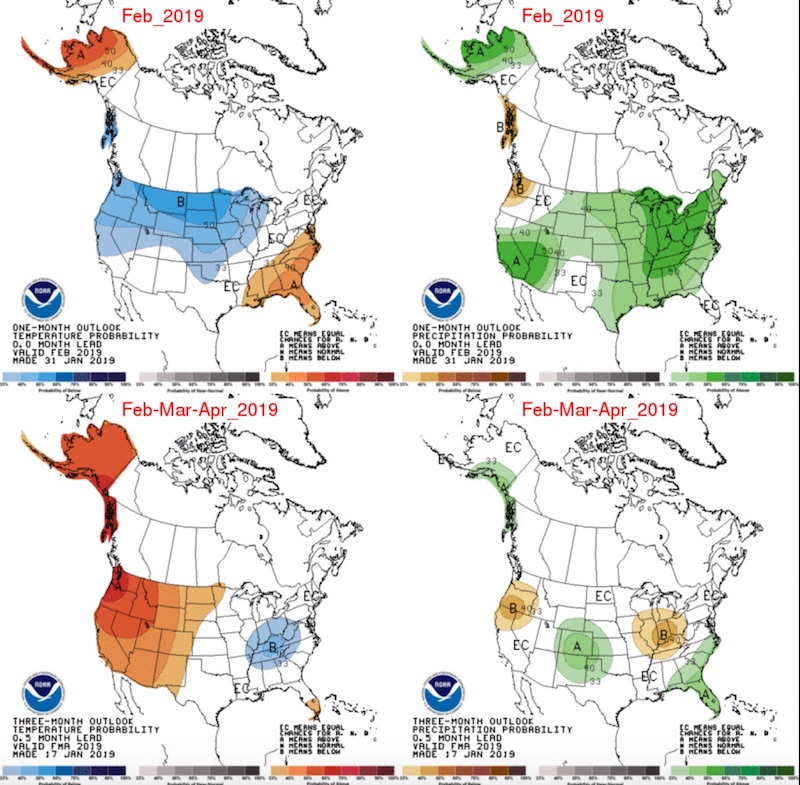
(A=Above Chance, B=Below Chance, EC=Equal Chance of A, B, and N - Normal Chance)
www.cpc.ncep.noaa.gov/products/predictio...ooks/color/page2.gif
Then again, maybe he's just wrong.
Groundhog Day 2019: How often has Punxsutawney Phil been correct?
By Leigh Morgan
Posted February 2, 2019 9:04 AM
Phil emerged from his burrow, did not see his shadow and predicted an early spring! Maybe? We're looking at a neutral El Nino which means a wetter spring and slightly above normal temps (3 month outlook for
Bailey
and
Evergreen
from NOAA).
(A=Above Chance, B=Below Chance, EC=Equal Chance of A, B, and N - Normal Chance)
www.cpc.ncep.noaa.gov/products/predictio...ooks/color/page2.gif
Then again, maybe he's just wrong.
Groundhog Day 2019: How often has Punxsutawney Phil been correct?
By Leigh Morgan
Posted February 2, 2019 9:04 AM
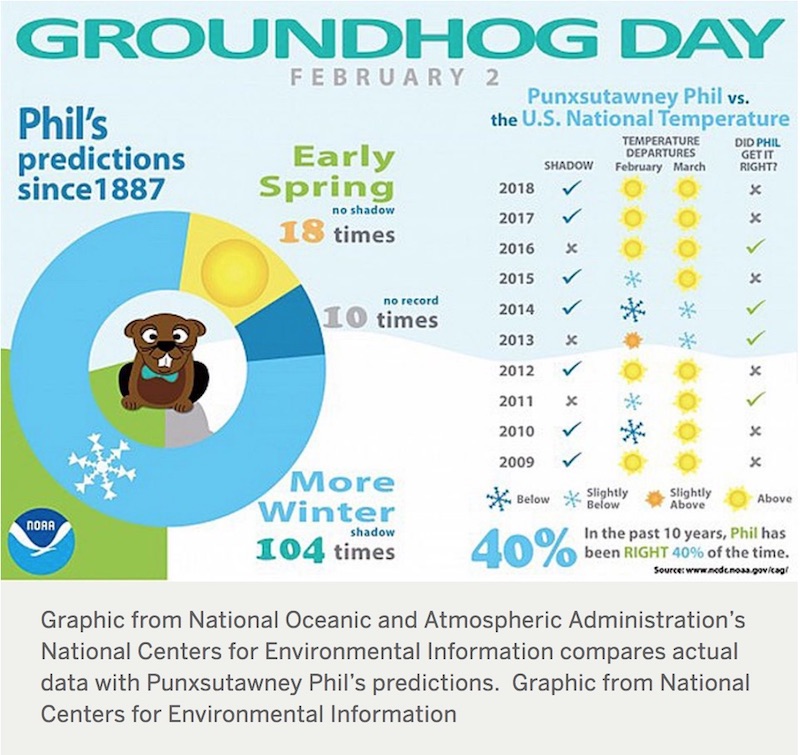
Groundhog Day by The National Centers for Environmental InformationThe day meteorologists love to hate is here. It’s Groundhog Day, so Punxsutawney Phil was again forced from his hidey-hole on Saturday (Feb. 2) to predict whether spring is just around the corner or six weeks in the future.
For 2019, Phil might be the darling of many. He predicted an early spring, which is unusual for him.
The groundhog uses his shadow to predict the onset of spring, but he might want to reconsider his methodology. His shadow has been correct only about 40 percent of the time in the past 10 years, according to the National Oceanic and Atmospheric Administration. Researchers have compared U.S. temperatures with Phil’s forecasts all the way back to 1887.
The agency’s National Centers for Environmental Information says Phil’s prediction skills are iffy at best.
"Now, more than ever, the illusions of division threaten our very existence. We all know the truth: more connects us than separates us. But in times of crisis the wise build bridges, while the foolish build barriers. We must find a way to look after one another as if we were one single tribe.” -King T'Challa, Black Panther
The truth is incontrovertible. Malice may attack it. ignorance may deride it, but in the end, there it is. ~Winston Churchill
Please Log in or Create an account to join the conversation.
Time to create page: 0.236 seconds
sponsors