
- Posts: 7923
- Thank you received: 70
Local History, Myths, and Legends
- otisptoadwater
-
 Topic Author
- Mountain Legend
-

Less
More
02 Mar 2014 20:04 #1
by otisptoadwater
I can explain it to you but I can't understand it for you.
"Any man who thinks he can be happy and prosperous by letting the Government take care of him; better take a closer look at the American Indian." - Henry Ford
Corruptissima re publica plurimae leges; When the Republic is at its most corrupt the laws are most numerous. - Publius Cornelius Tacitus
Local History, Myths, and Legends was created by otisptoadwater
I'm a fan of history and I really enjoy learning about the history of the area I live in. Facts, fiction, and the stuff in between are all of interest to me.
I'll start off with a topic most locals know well, The Reynolds Gang:
Many Confederate soldiers formed into militia groups during the War for Southern Independence in Colorado. They included the Fairplay Unit, Leadville Unit, Denver Unit, and Maces Hole. Col John Heffiner was the highest ranking Confederate to operate in the state. He and his officers were forming a regiment at Maces Hole in 1862. They were attacked and driven out of the territory by Union forces from Ft. Garland.
Southern sympathizers, the Reynolds Gang operated in South Park in 1864. In July of that year, Jim Reynolds and eight Confederate “soldiers” launched, what would become, the only invasion of the South Park area, in the Colorado Territory during the Civil War. Their plan was to rob the gold mines of South Park to help finance the Confederate Government.
Read more: http://clearcreekprospecting.com/the-reynolds-gang-stolen-treasure/
I'll start off with a topic most locals know well, The Reynolds Gang:
Many Confederate soldiers formed into militia groups during the War for Southern Independence in Colorado. They included the Fairplay Unit, Leadville Unit, Denver Unit, and Maces Hole. Col John Heffiner was the highest ranking Confederate to operate in the state. He and his officers were forming a regiment at Maces Hole in 1862. They were attacked and driven out of the territory by Union forces from Ft. Garland.
Southern sympathizers, the Reynolds Gang operated in South Park in 1864. In July of that year, Jim Reynolds and eight Confederate “soldiers” launched, what would become, the only invasion of the South Park area, in the Colorado Territory during the Civil War. Their plan was to rob the gold mines of South Park to help finance the Confederate Government.
Read more: http://clearcreekprospecting.com/the-reynolds-gang-stolen-treasure/
I can explain it to you but I can't understand it for you.
"Any man who thinks he can be happy and prosperous by letting the Government take care of him; better take a closer look at the American Indian." - Henry Ford
Corruptissima re publica plurimae leges; When the Republic is at its most corrupt the laws are most numerous. - Publius Cornelius Tacitus
Please Log in or Create an account to join the conversation.
- Venturer
-

- Mountain Legend
-
Less
More
- Posts: 877
- Thank you received: 0
02 Mar 2014 20:54 #2
by Venturer
Replied by Venturer on topic Local History, Myths, and Legends
Trappers in the mountains of South Park in the 1830's used to cache their furs and then they were taken to Taos or Santa Fe or St. Louis. After Bent's Fort was built they were taken down the Arkansas to the Fort for trading.
OPTW do you recall the Rocky Mountain Fur Company and the names Joseph Meeks, Sublette and Wooten? My family used to tell us stories about their escapades as trappers.
OPTW do you recall the Rocky Mountain Fur Company and the names Joseph Meeks, Sublette and Wooten? My family used to tell us stories about their escapades as trappers.
Please Log in or Create an account to join the conversation.
- otisptoadwater
-
Topic Author
- Mountain Legend
-
Less
More
- Posts: 7923
- Thank you received: 70
02 Mar 2014 21:29 #3
by otisptoadwater
I can explain it to you but I can't understand it for you.
"Any man who thinks he can be happy and prosperous by letting the Government take care of him; better take a closer look at the American Indian." - Henry Ford
Corruptissima re publica plurimae leges; When the Republic is at its most corrupt the laws are most numerous. - Publius Cornelius Tacitus
Replied by otisptoadwater on topic Local History, Myths, and Legends
I'm not from here (but I got here as fast as I could) so I don't have the wealth of knowledge that multiple generations of locals do. That doesn't mean I'm only interested in the highlights, I want to learn as much as I can and I enjoy knowing more about where I live and my surroundings.
I do know about the fur trades in the early 1800s and I recognize the names Meeks, Sublette, and Wooten but I don't know about any specific exploits. I'd love to read anything you want to share about those individuals and the fur trade be it fact, fiction, or anything in between.
I do know about the fur trades in the early 1800s and I recognize the names Meeks, Sublette, and Wooten but I don't know about any specific exploits. I'd love to read anything you want to share about those individuals and the fur trade be it fact, fiction, or anything in between.
I can explain it to you but I can't understand it for you.
"Any man who thinks he can be happy and prosperous by letting the Government take care of him; better take a closer look at the American Indian." - Henry Ford
Corruptissima re publica plurimae leges; When the Republic is at its most corrupt the laws are most numerous. - Publius Cornelius Tacitus
Please Log in or Create an account to join the conversation.
- Venturer
-
- Mountain Legend
-
Less
More
- Posts: 877
- Thank you received: 0
03 Mar 2014 08:49 #4
by Venturer
Replied by Venturer on topic Local History, Myths, and Legends
We heard a lot of stories from our grandparents and parents who grew up in South Park.
During the months of October and November trappers came from all over but mostly from Santa Fe, Taos and St. Louis to trap beavers as this was the prime season, when they would get the most money for their furs. My grandparents said that family could always tell when trapping was going on cuz you could smell the trap bait before ever getting to it. And if you have ever eaten venison it could have a strong taste depending on what they ate. The same with the beaver. You could always tell when boiling the meat what it ate and how strong the taste would be. I asked my grandparents if they carried a pot with them to boil the meat. They said that they had some huts or cellars with tools and other necessities at each location along their line routes. It was mostly a solitary existence and if they got hurt they were on their own to fix the problem.
During the months of October and November trappers came from all over but mostly from Santa Fe, Taos and St. Louis to trap beavers as this was the prime season, when they would get the most money for their furs. My grandparents said that family could always tell when trapping was going on cuz you could smell the trap bait before ever getting to it. And if you have ever eaten venison it could have a strong taste depending on what they ate. The same with the beaver. You could always tell when boiling the meat what it ate and how strong the taste would be. I asked my grandparents if they carried a pot with them to boil the meat. They said that they had some huts or cellars with tools and other necessities at each location along their line routes. It was mostly a solitary existence and if they got hurt they were on their own to fix the problem.
Please Log in or Create an account to join the conversation.
- otisptoadwater
-
Topic Author
- Mountain Legend
-
Less
More
- Posts: 7923
- Thank you received: 70
03 Mar 2014 20:26 #5
by otisptoadwater
I can explain it to you but I can't understand it for you.
"Any man who thinks he can be happy and prosperous by letting the Government take care of him; better take a closer look at the American Indian." - Henry Ford
Corruptissima re publica plurimae leges; When the Republic is at its most corrupt the laws are most numerous. - Publius Cornelius Tacitus
Replied by otisptoadwater on topic Local History, Myths, and Legends
[center:287t3r0i]
 [/center:287t3r0i]
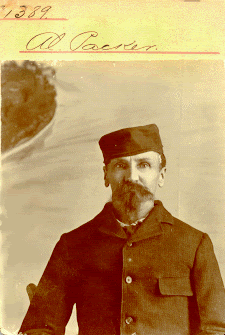
How about the life and times of Alferd Packer? Most folks are familiar with the tale of Alferd leading a party into the mountains and allegedly eating the members of the party when they got stuck in bad weather. But did you know what happened to Alferd after he was convicted?
Having changed his story twice and with no corroboration available from the now-buried corpses, the jury convicted Packer of the single murder and he was sentenced to hang. Three years later the conviction was overturned, however, due to a legislative error made in the criminal codes when Colorado changed from a territory to a state in 1876.
Packer was tried again, charged with five counts of manslaughter and was convicted and sentenced to forty years in prison. He was remanded to the State Prison in Canon City in 1886. Due to the efforts of Denver Post editors and reporter Polly Pry, who were convinced of his innocence, he was paroled in 1901 and went to work as a guard at the Post.
He spent the final years of his life living in and around Littleton —on Harrison Avenue and on west Hampden. His last address was the Van Alstine ranch in Deer Creek Canyon. "He was described as a kindly man who would take children on his lap and tell them of his early days in the old west," according to Littleton historian Dave Hicks. He died April 24, 1907, evidently of liver and stomach troubles. Because he was a Civil War veteran, the military paid for the funeral and provided the tombstone, which reads: "Alfred Packer, Co. F, 16 U.S. Inf." His dying words, according to the Littleton Independent, were "I'm not guilty of the charge."
Read more: https://www.littletongov.org/index.aspx?page=321
How about the life and times of Alferd Packer? Most folks are familiar with the tale of Alferd leading a party into the mountains and allegedly eating the members of the party when they got stuck in bad weather. But did you know what happened to Alferd after he was convicted?
Having changed his story twice and with no corroboration available from the now-buried corpses, the jury convicted Packer of the single murder and he was sentenced to hang. Three years later the conviction was overturned, however, due to a legislative error made in the criminal codes when Colorado changed from a territory to a state in 1876.
Packer was tried again, charged with five counts of manslaughter and was convicted and sentenced to forty years in prison. He was remanded to the State Prison in Canon City in 1886. Due to the efforts of Denver Post editors and reporter Polly Pry, who were convinced of his innocence, he was paroled in 1901 and went to work as a guard at the Post.
He spent the final years of his life living in and around Littleton —on Harrison Avenue and on west Hampden. His last address was the Van Alstine ranch in Deer Creek Canyon. "He was described as a kindly man who would take children on his lap and tell them of his early days in the old west," according to Littleton historian Dave Hicks. He died April 24, 1907, evidently of liver and stomach troubles. Because he was a Civil War veteran, the military paid for the funeral and provided the tombstone, which reads: "Alfred Packer, Co. F, 16 U.S. Inf." His dying words, according to the Littleton Independent, were "I'm not guilty of the charge."
Read more: https://www.littletongov.org/index.aspx?page=321
I can explain it to you but I can't understand it for you.
"Any man who thinks he can be happy and prosperous by letting the Government take care of him; better take a closer look at the American Indian." - Henry Ford
Corruptissima re publica plurimae leges; When the Republic is at its most corrupt the laws are most numerous. - Publius Cornelius Tacitus
Please Log in or Create an account to join the conversation.
- Freezeman
-

- Mountain Advisor
-

Less
More
- Posts: 295
- Thank you received: 7
04 Mar 2014 08:36 #6
by Freezeman
Replied by Freezeman on topic Local History, Myths, and Legends
Thanks for that link Toadwater. Maybe you would be interested in taking a look at a 1800's large blown up safe I found buried at Webster?
Please Log in or Create an account to join the conversation.
- otisptoadwater
-
Topic Author
- Mountain Legend
-
Less
More
- Posts: 7923
- Thank you received: 70
04 Mar 2014 19:29 #7
by otisptoadwater
I can explain it to you but I can't understand it for you.
"Any man who thinks he can be happy and prosperous by letting the Government take care of him; better take a closer look at the American Indian." - Henry Ford
Corruptissima re publica plurimae leges; When the Republic is at its most corrupt the laws are most numerous. - Publius Cornelius Tacitus
Replied by otisptoadwater on topic Local History, Myths, and Legends
One of the skills I picked up outside of my assigned duties in the Navy involved some limited locksmith work. It's always interesting to see how older locks were put together and how they can be defeated. More importantly, do you know the back story about how the safe came to be where it is and why it was opened in an "unconventional" way?
I can explain it to you but I can't understand it for you.
"Any man who thinks he can be happy and prosperous by letting the Government take care of him; better take a closer look at the American Indian." - Henry Ford
Corruptissima re publica plurimae leges; When the Republic is at its most corrupt the laws are most numerous. - Publius Cornelius Tacitus
Please Log in or Create an account to join the conversation.
- Venturer
-
- Mountain Legend
-
Less
More
- Posts: 877
- Thank you received: 0
04 Mar 2014 19:50 #8
by Venturer
Replied by Venturer on topic Local History, Myths, and Legends
Yes thank you for the link OPTW. Would enjoy seeing pix of safe Freezeman.
We spent many evenings reading or listening to the writings and travels of John L. Dyer, The Snow-shoe Itinerant.
Tracking The Snow-shoe Itinerant
http://www.mountainmagazine.com/snowsto ... erant2.htm
The Denver Post
"His dramatic photographs show snowstorms hovering over desolate mountains, streams clogged with ice, the white bones of aspen trees covered with snow, brittle cold nights with bright stars like giant snowflakes. Sandra Dallas for theDenver Post continues. Breckenridge photographer Kent Gunnufson has used THE SNOWSHOE ITINERANT, the autobiography of the early-day Methodist circuit rider FR. John Dyer, as the basis of a photographic study of South Park and Summit County. Father Dyer’s diary, published 100 years ago, provides endless inspiration, since the preacher comments on everything from gold strikes to Godless men, from the price of a meal to the amount in the collection plate, and always he talks about the howling snow that falls 11 months of the year in the high country.
"At one point Father Dyer despairs: ‘no pen or tongue can describe its awful appearance.’ But photographs can. And Gunnufson, like Father Dyer, is overwhelmed by the snow. His photographs are not of pretty mountain scenes but of the cold and awesome land at timberline that bedeviled Father Dyer.
More at the link - an excerpt from his book.
We spent many evenings reading or listening to the writings and travels of John L. Dyer, The Snow-shoe Itinerant.
Tracking The Snow-shoe Itinerant
http://www.mountainmagazine.com/snowsto ... erant2.htm
The Denver Post
"His dramatic photographs show snowstorms hovering over desolate mountains, streams clogged with ice, the white bones of aspen trees covered with snow, brittle cold nights with bright stars like giant snowflakes. Sandra Dallas for theDenver Post continues. Breckenridge photographer Kent Gunnufson has used THE SNOWSHOE ITINERANT, the autobiography of the early-day Methodist circuit rider FR. John Dyer, as the basis of a photographic study of South Park and Summit County. Father Dyer’s diary, published 100 years ago, provides endless inspiration, since the preacher comments on everything from gold strikes to Godless men, from the price of a meal to the amount in the collection plate, and always he talks about the howling snow that falls 11 months of the year in the high country.
"At one point Father Dyer despairs: ‘no pen or tongue can describe its awful appearance.’ But photographs can. And Gunnufson, like Father Dyer, is overwhelmed by the snow. His photographs are not of pretty mountain scenes but of the cold and awesome land at timberline that bedeviled Father Dyer.
More at the link - an excerpt from his book.
Please Log in or Create an account to join the conversation.
- otisptoadwater
-
Topic Author
- Mountain Legend
-
Less
More
- Posts: 7923
- Thank you received: 70
04 Mar 2014 19:57 #9
by otisptoadwater
I can explain it to you but I can't understand it for you.
"Any man who thinks he can be happy and prosperous by letting the Government take care of him; better take a closer look at the American Indian." - Henry Ford
Corruptissima re publica plurimae leges; When the Republic is at its most corrupt the laws are most numerous. - Publius Cornelius Tacitus
Replied by otisptoadwater on topic Local History, Myths, and Legends
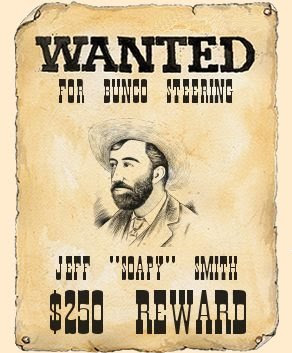
Another character that left his imprint on Colorado was Jefferson Randolph "Soapy" Smith:
[center:2r9l7lyd]
 [/center:2r9l7lyd]
One such con-man was Jefferson Randolph Smith who arrived in Leadville in the mid 1800's. It wasn't long before residents found Smith and his partner operating a shell game on the corner of Harrison Ave and Third Street. Smith seemed to be a natural at the con game, learning quickly from his already experienced partner. The shell game became quite successful, but Smith and his partner knew it could only last so long, so they expanded their operation to an exercise that ultimately gave Smith his nickname: "Soapy".
What better product to try and sell in the wild and crazy boom town of Leadville than soap? He started this new project by wrapping a $100 bill around a bar of soap, re-wrapping it with his own label, and placing it in a box with numerous other bars of soap, all bearing the name of his new product "Sapolion". He then walked inside one of the local saloons, where his silent partner "bought" one of the bars of soap from Smith, and upon opening it (in front of the other patrons) was "surprised" to find a crisp one hundred dollar bill under the wrapping! Needless to say soap sales escalated at a phenomenal rate for "Soapy".
Read more: http://www.leadville.com/history/soapy.htm
[center:2r9l7lyd]
One such con-man was Jefferson Randolph Smith who arrived in Leadville in the mid 1800's. It wasn't long before residents found Smith and his partner operating a shell game on the corner of Harrison Ave and Third Street. Smith seemed to be a natural at the con game, learning quickly from his already experienced partner. The shell game became quite successful, but Smith and his partner knew it could only last so long, so they expanded their operation to an exercise that ultimately gave Smith his nickname: "Soapy".
What better product to try and sell in the wild and crazy boom town of Leadville than soap? He started this new project by wrapping a $100 bill around a bar of soap, re-wrapping it with his own label, and placing it in a box with numerous other bars of soap, all bearing the name of his new product "Sapolion". He then walked inside one of the local saloons, where his silent partner "bought" one of the bars of soap from Smith, and upon opening it (in front of the other patrons) was "surprised" to find a crisp one hundred dollar bill under the wrapping! Needless to say soap sales escalated at a phenomenal rate for "Soapy".
Read more: http://www.leadville.com/history/soapy.htm
I can explain it to you but I can't understand it for you.
"Any man who thinks he can be happy and prosperous by letting the Government take care of him; better take a closer look at the American Indian." - Henry Ford
Corruptissima re publica plurimae leges; When the Republic is at its most corrupt the laws are most numerous. - Publius Cornelius Tacitus
Please Log in or Create an account to join the conversation.
- Venturer
-
- Mountain Legend
-
Less
More
- Posts: 877
- Thank you received: 0
04 Mar 2014 20:30 #10
by Venturer
Replied by Venturer on topic Local History, Myths, and Legends
I remember talk of him. He knew every confidence game there was.
Here's a link that talks extensively about Soapy's bad deeds. Quite interesting.
http://www.soapysmith.net/
Here's a link that talks extensively about Soapy's bad deeds. Quite interesting.
http://www.soapysmith.net/
Please Log in or Create an account to join the conversation.
Time to create page: 0.187 seconds
sponsors