
- Posts: 14880
- Thank you received: 27
The Deafness Before the Storm (9/11 Negligence)....
- LadyJazzer
-
 Topic Author
- Mountain Legend
-

Less
More
10 Sep 2012 23:50 - 11 Sep 2012 20:52 #1
by LadyJazzer
There's more... But this should be enough to make you angry...Unless, of course, you are one of the Bush-deniers who still have your head stuck in the sand....
The Deafness Before the Storm (9/11 Negligence).... was created by LadyJazzer
http://www.nytimes.com/2012/09/11/opini ... .html?_r=1The Deafness Before the Storm
On Aug. 6, 2001, President George W. Bush received a classified review of the threats posed by Osama bin Laden and his terrorist network, Al Qaeda. That morning’s “presidential daily brief” — the top-secret document prepared by America’s intelligence agencies — featured the now-infamous heading: “Bin Laden Determined to Strike in U.S.” A few weeks later, on 9/11, Al Qaeda accomplished that goal.
On April 10, 2004, the Bush White House declassified that daily brief — and only that daily brief — in response to pressure from the 9/11 Commission, which was investigating the events leading to the attack. Administration officials dismissed the document’s significance, <more> While some critics considered that claim absurd, a close reading of the brief showed that the argument had some validity.
[T]he C.I.A. repeated the warnings in the briefs that followed. Operatives connected to Bin Laden, one reported on June 29, expected the planned near-term attacks to have “dramatic consequences,” including major casualties. On July 1, the brief stated that the operation had been delayed, but “will occur soon.” Some of the briefs again reminded Mr. Bush that the attack timing was flexible, and that, despite any perceived delay, the planned assault was on track. Yet, the White House failed to take significant action. Officials at the Counterterrorism Center of the C.I.A. grew apoplectic. On July 9, at a meeting of the counterterrorism group, one official suggested that the staff put in for a transfer so that somebody else would be responsible when the attack took place, two people who were there told me in interviews. ... <more>
In the aftermath of 9/11, Bush officials attempted to deflect criticism that they had ignored C.I.A. warnings by saying they had not been told when and where the attack would occur. That is true, as far as it goes, but it misses the point. Throughout that summer, there were events that might have exposed the plans, had the government been on high alert. ....<more>
There's more... But this should be enough to make you angry...Unless, of course, you are one of the Bush-deniers who still have your head stuck in the sand....
Last edit: 11 Sep 2012 20:52 by LadyJazzer.
Please Log in or Create an account to join the conversation.
- LadyJazzer
-
Topic Author
- Mountain Legend
-
Less
More
- Posts: 14880
- Thank you received: 27
10 Sep 2012 23:58 #2
by LadyJazzer
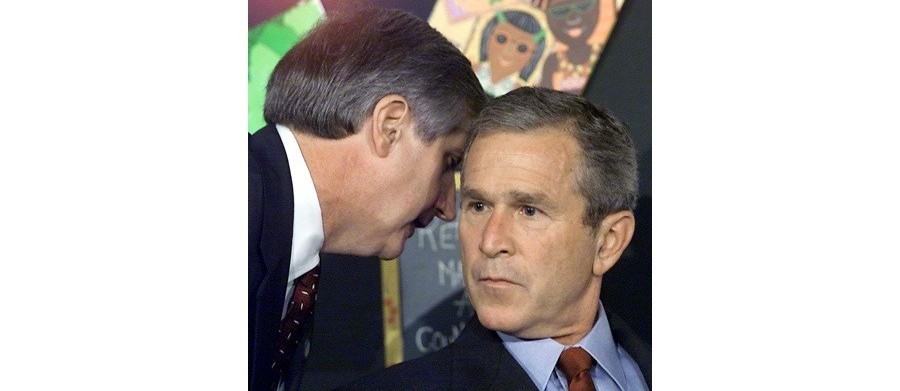
What do you mean "I left the seat up?"
Replied by LadyJazzer on topic The Deafness Before the Storm (9/11 Negligence)....
What do you mean "I left the seat up?"
Please Log in or Create an account to join the conversation.
- FredHayek
-

- Mountain Legend
-
Less
More
- Posts: 31360
- Thank you received: 181
11 Sep 2012 03:54 #3
by FredHayek
Thomas Sowell: There are no solutions, just trade-offs.
Replied by FredHayek on topic The Deafness Before the Storm (9/11 Negligence)....
It must be that time of year again, LJ trotting out her 9/11 Bush conspiracies. Are you about to go truther on us too?
And did FDR sacrifice the people at Pearl Harbor to create a pretext for war with Germany too?
And did FDR sacrifice the people at Pearl Harbor to create a pretext for war with Germany too?
Thomas Sowell: There are no solutions, just trade-offs.
Please Log in or Create an account to join the conversation.
- Reverend Revelant
-

- Mountain Legend
-
Less
More
- Posts: 7163
- Thank you received: 21
11 Sep 2012 05:07 #4
by Reverend Revelant
Waiting for Armageddon since 33 AD
Replied by Reverend Revelant on topic The Deafness Before the Storm (9/11 Negligence)....
Why is Obama skipping more than half of his daily intelligence meetings?
Obama isn't worried, Valarie Jarrett is running things.
President Obama is touting his foreign policy experience on the campaign trail, but startling new statistics suggest that national security has not necessarily been the personal priority the president makes it out to be. It turns out that more than half the time, the commander in chief does not attend his daily intelligence meeting.
The Government Accountability Institute, a new conservative investigative research organization, examined President Obama’s schedule from the day he took office until mid-June 2012, to see how often he attended his Presidential Daily Brief (PDB) — the meeting at which he is briefed on the most critical intelligence threats to the country. During his first 1,225 days in office, Obama attended his PDB just 536 times — or 43.8 percent of the time. During 2011 and the first half of 2012, his attendance became even less frequent — falling to just over 38 percent. By contrast, Obama’s predecessor, George W. Bush almost never missed his daily intelligence meeting.
While the Bush records are not yet available electronically for analysis, officials tell me the former president held his intelligence meeting six days a week, no exceptions — usually with the vice president, the White House chief of staff, the national security adviser, the director of National Intelligence, or their deputies, and CIA briefers in attendance. Once a week, he held an expanded Homeland Security briefing that included the Homeland Security adviser, the FBI director and other homeland security officials. Bush also did more than 100 hour-long “deep dives” in which he invited intelligence analysts into the Oval Office to get their unvarnished and sometimes differing views. Such meetings deepened the president’s understanding of the issues and helped analysts better understand the problems with which he was wrestling.
http://www.washingtonpost.com/opinions/ ... story.html
Obama isn't worried, Valarie Jarrett is running things.
Waiting for Armageddon since 33 AD
Please Log in or Create an account to join the conversation.
- LadyJazzer
-
Topic Author
- Mountain Legend
-
Less
More
- Posts: 14880
- Thank you received: 27
11 Sep 2012 06:41 #5
by LadyJazzer
Replied by LadyJazzer on topic The Deafness Before the Storm (9/11 Negligence)....
Why, yes, it IS "that time of year"...again. I didn't want anyone to forget the incompetence of the Idiot Son...
Another interesting factoid: Bush 43 set a new record for "time out of office" before 9/11 ...
Another interesting factoid: Bush 43 set a new record for "time out of office" before 9/11 ...
Please Log in or Create an account to join the conversation.
Time to create page: 0.220 seconds
sponsors