
- Posts: 2915
- Thank you received: 3
Being in the Civil Air Patrol does not make one a Veteran
- Grady
-
 Topic Author
- Mountain Legend
-

Less
More
10 Nov 2012 16:17 #1
by Grady
Being in the Civil Air Patrol does not make one a Veteran was created by Grady
With Veteran’s day tomorrow I thought I’d take the opportunity to clear up any misconceptions people might have.
Please Log in or Create an account to join the conversation.
- Martin Ent Inc
-

- Mountain Legend
-
Less
More
- Posts: 6540
- Thank you received: 0
10 Nov 2012 18:02 #2
by Martin Ent Inc
Replied by Martin Ent Inc on topic Being in the Civil Air Patrol does not make one a Veteran
There is only 1 DUMBASS that thinks differently and never even finished the course.
Please Log in or Create an account to join the conversation.
- UNDER MODERATION
-

- Visitor
-

10 Nov 2012 19:02 #3
by UNDER MODERATION
Replied by UNDER MODERATION on topic Being in the Civil Air Patrol does not make one a Veteran
Yes it does, its an auxuliry Branch of the Air Force and thats what it says on my Military ID card.
A fellow CAP vetran sent me a file and I printed it but I cant find the file so I took some pic's of it for you other vetrans who want free meals this week. If you plan carefull you can hit them all because the offers usually span over a few days
Check it out:
Completely Free Meals
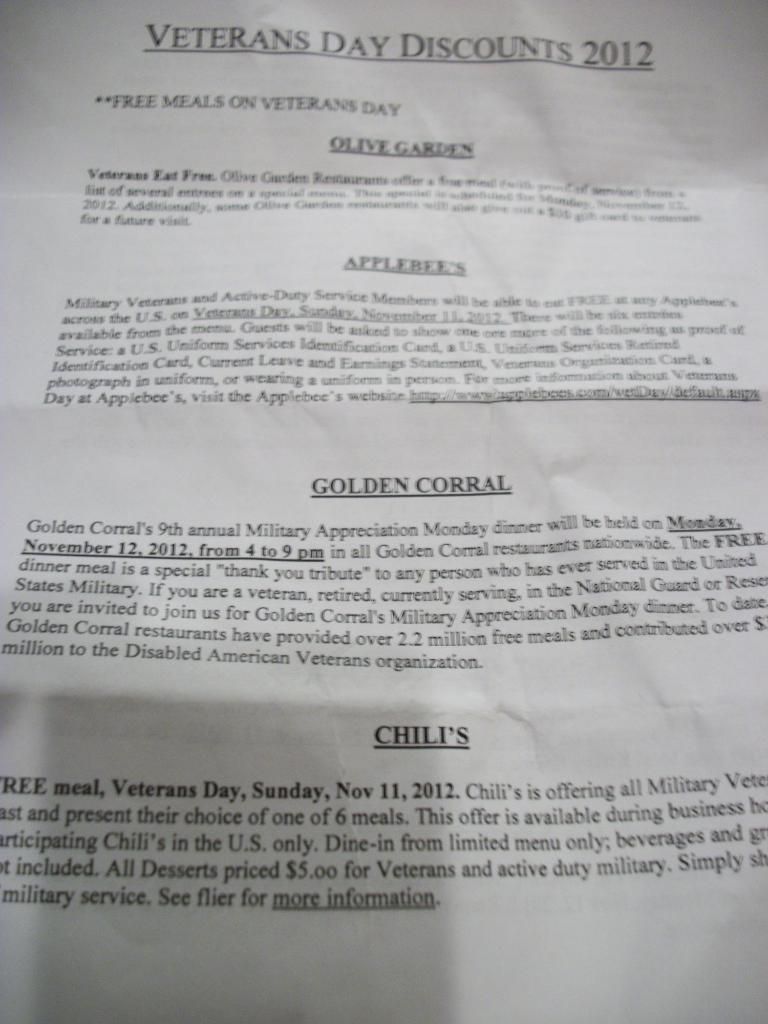
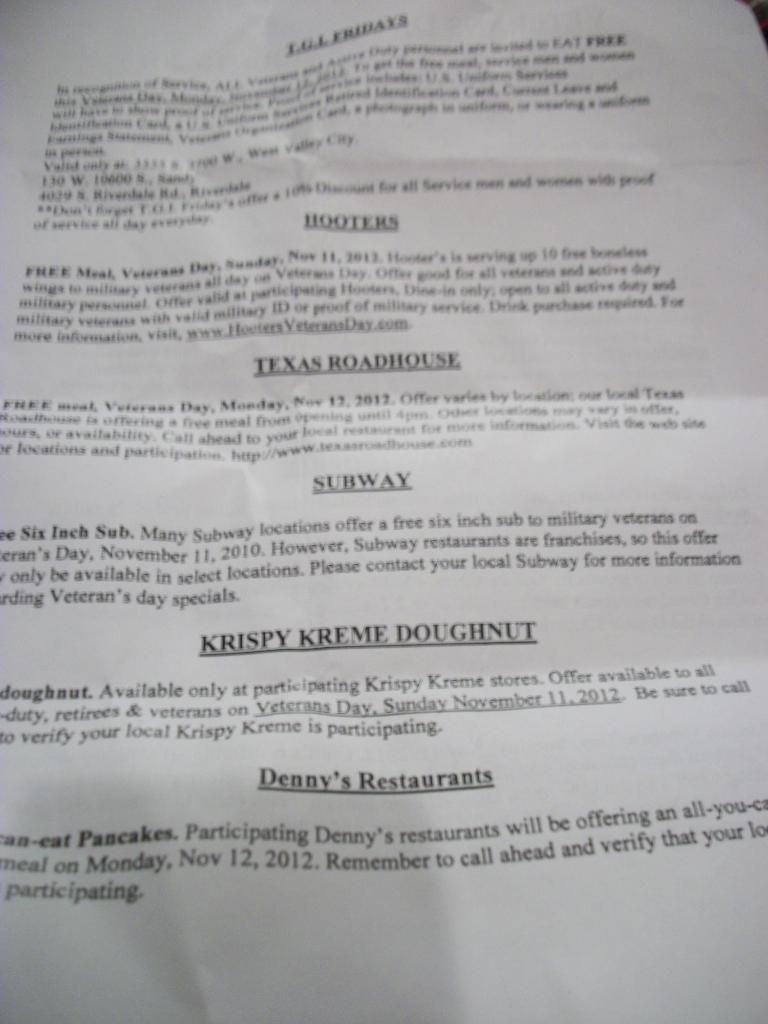
Other Discounts
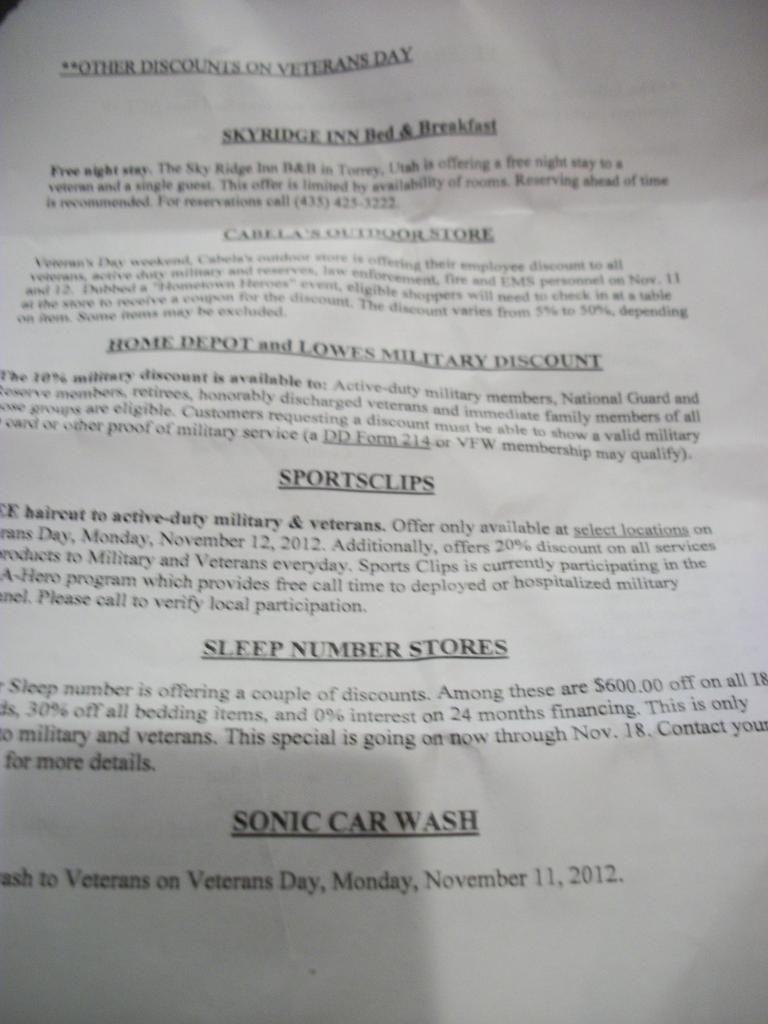
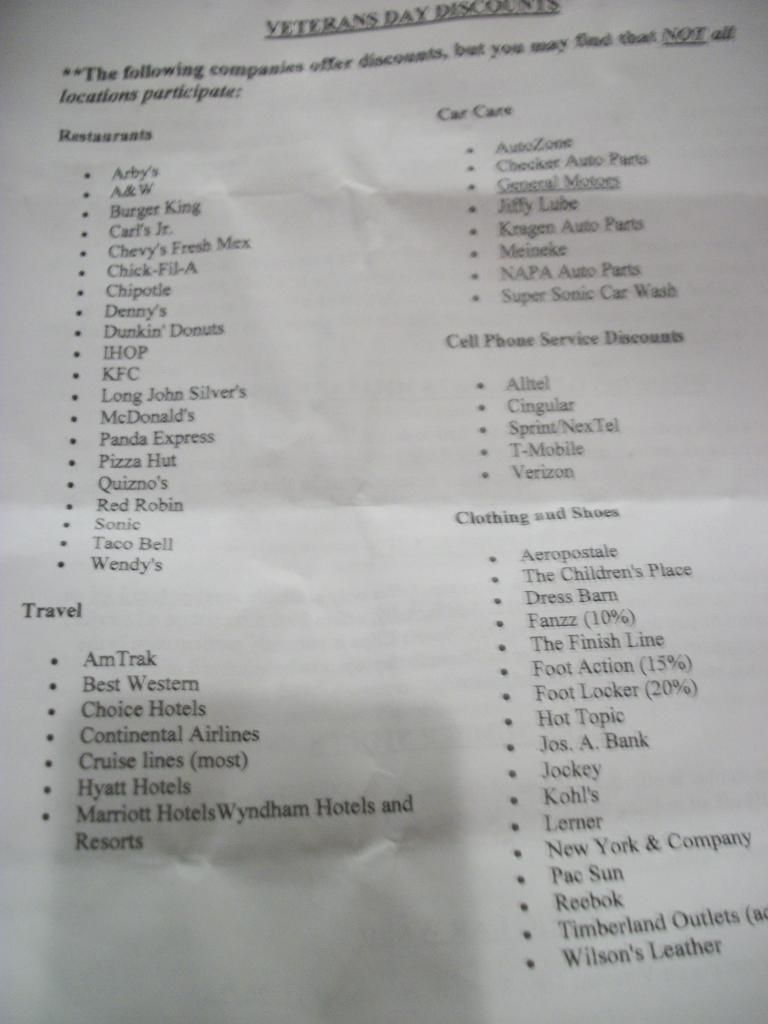
A fellow CAP vetran sent me a file and I printed it but I cant find the file so I took some pic's of it for you other vetrans who want free meals this week. If you plan carefull you can hit them all because the offers usually span over a few days
Check it out:
Completely Free Meals
Other Discounts
Please Log in or Create an account to join the conversation.
- navycpo7
-
- Mountain Legend
-
Less
More
- Posts: 2093
- Thank you received: 26
10 Nov 2012 22:02 #4
by navycpo7
You are not a veteran you have never been a veteran and you will never be a veteran. Now if you want to run your mouth about being a veteran, since most know you lie about it all the time, do it to a real veteran. We don't care to much for those that like to lie about it. Something you would know nothing about. Then again, you did try to lie and were caught in every lie you told. Guess you got to be good at something, but your no good at lying either. You also got caught telling your lies about CAP also. CAP is not a part of the military, it is a auxiliary nothing more.
Replied by navycpo7 on topic Being in the Civil Air Patrol does not make one a Veteran
Big Doug wrote: Yes it does, its an auxuliry Branch of the Air Force and thats what it says on my Military ID card.
A fellow CAP vetran sent me a file and I printed it but I cant find the file so I took some pic's of it for you other vetrans who want free meals this week. If you plan carefull you can hit them all because the offers usually span over a few days
Check it out:
Completely Free Meals
Other Discounts
You are not a veteran you have never been a veteran and you will never be a veteran. Now if you want to run your mouth about being a veteran, since most know you lie about it all the time, do it to a real veteran. We don't care to much for those that like to lie about it. Something you would know nothing about. Then again, you did try to lie and were caught in every lie you told. Guess you got to be good at something, but your no good at lying either. You also got caught telling your lies about CAP also. CAP is not a part of the military, it is a auxiliary nothing more.
Please Log in or Create an account to join the conversation.
- otisptoadwater
-

- Mountain Legend
-
Less
More
- Posts: 7923
- Thank you received: 70
10 Nov 2012 22:09 #5
by otisptoadwater
I can explain it to you but I can't understand it for you.
"Any man who thinks he can be happy and prosperous by letting the Government take care of him; better take a closer look at the American Indian." - Henry Ford
Corruptissima re publica plurimae leges; When the Republic is at its most corrupt the laws are most numerous. - Publius Cornelius Tacitus
Replied by otisptoadwater on topic Being in the Civil Air Patrol does not make one a Veteran
It occurs to me that a free meal is available 24X7, 365 days a year at the Denver Rescue Mission; at the same time it occurs to me that VL isn't deserving of charity nor recognition as a Veteran.
I can explain it to you but I can't understand it for you.
"Any man who thinks he can be happy and prosperous by letting the Government take care of him; better take a closer look at the American Indian." - Henry Ford
Corruptissima re publica plurimae leges; When the Republic is at its most corrupt the laws are most numerous. - Publius Cornelius Tacitus
Please Log in or Create an account to join the conversation.
- The Boss
-

- Mountain Legend
-
Less
More
- Posts: 1688
- Thank you received: 0
11 Nov 2012 06:03 - 13 Nov 2012 08:13 #6
by The Boss
Replied by The Boss on topic Being in the Civil Air Patrol does not make one a Veteran
hmmmm.
Last edit: 13 Nov 2012 08:13 by The Boss.
Please Log in or Create an account to join the conversation.
- navycpo7
-
- Mountain Legend
-
Less
More
- Posts: 2093
- Thank you received: 26
11 Nov 2012 06:59 #7
by navycpo7
National Guard and Military reservist are Veterans. Being a Reservist and National Guard now days isn't a whole lot different than being on Active Duty. I was in the Civil Air Patrol. At one point I was the Squadron Commander of the Platte Canyon Griffins. We eventually merged with the Evergreen Composite Squadron. The Squadron Commander of the Evergreen Squadron is also a Veteran and a member of my VFW Post. Civil Air Patrol is not a part of the military. During WWII, they did do a lot of flying for what we now call Homeland Security and were actually credited with locating a submarine. Now days they do a lot of flying as Search and Rescue missions. They have taken over a majority of that from the US Air Force due to the limited availability the Air Force has due to the war and everything else they do. Some of the missions, if approved by the Air Force, gets funding from the Air Force. The CAP is more like JROTC. They have a rank structure, etc. The adults, also have the rank structure. The adults do not have to adhere to any kind of grooming standards unless they want to wear the old Air Force uniforms. Then they must follow the military grooming standards. The cadets have to follow the grooming standards. They teach Aerospace Education, Search and Rescue and many more things, including military customs, discipline, marching etc. They can earn awards, ribbons etc. Those that attain the rank of Cadet 2nd Lt and above when and if joining the military, can actually if given it, go in as a higher rank. (instead of E1 can go in as E2 or E3). Civil Air Patrol is strictly a volunteer organization. They do a lot of good within thier communities and states. Each member has to pay annual dues also. Most of thier funding comes via donations from large Corporations and then through various members and groups. The VFW even has a Cadet NCO and a Cadet Officer award, that is given annually.
Civil Air Patrol: A Proud Legacy Continues
Civil Air Patrol enjoys a proud legacy of selfless sacrifice and service to country and community that spans decades.
The first Civil Air Patrol members of 1941 were a heroic breed, men and women who served their country by sinking or chasing away German submarines off America's East and Gulf coasts. As a result of their bravery, patriotism and tenacity, CAP subchasers effectively thwarted German U-boat attacks and, in the process, saved countless lives.
Today, CAP handles 90 percent of inland search and rescue missions, with approximately 75 lives saved each year. Our members are generally the first on the scene transmitting satellite digital images of the damage within seconds around the world and providing disaster relief and emergency services following natural and manmade disasters, including such phenomena as 9/11, Hurricane Katrina, Texas and Oklahoma wildfires, tornadoes in the south and central U.S., North Dakota flash flooding and the October 2006 earthquake in Hawaii, as well as humanitarian missions along the U.S. and Mexican border.
In addition, CAP members are dedicated to counterdrug reconnaissance and to teaching a new generation about aerospace and its impact on our future. And our cadet programs ensure our youth receive some of the finest leadership training the nation has to offer.
Unlike our founding CAP fathers, many of whom flew their own airplanes and performed life-threatening missions without any formal training, our more than 60,000 members are now provided with top-notch, year-round professional development training opportunities and with aircraft equipped with the most advanced technologies available for search and rescue.
Indeed, Civil Air Patrol makes a huge impact each and every day, going above and beyond to make a profound difference in America's communities. As a vigilant CAP volunteer, you save lives and preserve liberty for all. Thank you for your service.
Replied by navycpo7 on topic Being in the Civil Air Patrol does not make one a Veteran
on that note wrote: From their site....
[quoteem:2il87eg3]Home » About
History of Civil Air Patrol
Piper Cub 1966In the late 1930s, more than 150,000 volunteers with a love for aviation argued for an organization to put their planes and flying skills to use in defense of their country. As a result, the Civil Air Patrol was born one week prior to the Japanese attack on Pearl Harbor. Thousands of volunteer members answered America's call to national service and sacrifice by accepting and performing critical wartime missions. Assigned to the War Department under the jurisdiction of the Army Air Corps, the contributions of Civil Air Patrol, including logging more than 500,000 flying hours, sinking two enemy submarines, and saving hundreds of crash victims during World War II, are well documented.
After the war, a thankful nation understood that Civil Air Patrol could continue providing valuable services to both local and national agencies. On July 1, 1946, President Harry Truman signed Public Law 476 incorporating Civil Air Patrol as a benevolent, nonprofit organization. On May 26, 1948, Congress passed Public Law 557 permanently establishing Civil Air Patrol as the auxiliary of the new U.S. Air Force. Three primary mission areas were set forth at that time: aerospace education, cadet programs, and emergency services.
In the late 1930s, more than 150,000 volunteers with a love for aviation argued for an organization to put their planes and flying skills to use in defense of their country. As a result, the Civil Air Patrol was born one week prior to the Japanese attack on Pearl Harbor. Thousands of volunteer members answered America's call to national service and sacrifice by accepting and performing critical wartime missions. Assigned to the War Department under the jurisdiction of the Army Air Corps, the contributions of Civil Air Patrol, including logging more than 500,000 flying hours, sinking two enemy submarines, and saving hundreds of crash victims during World War II, are well documented.
After the war, a thankful nation understood that Civil Air Patrol could continue providing valuable services to both local and national agencies. On July 1, 1946, President Harry Truman signed Public Law 476 incorporating Civil Air Patrol as a benevolent, nonprofit organization. On May 26, 1948, Congress passed Public Law 557 permanently establishing Civil Air Patrol as the auxiliary of the new U.S. Air Force. Three primary mission areas were set forth at that time: aerospace education, cadet programs, and emergency services.[/quoteem:2il87eg3]
Just so we are clear. Those that serve in the National Guard and Reserves, vets or not?
National Guard and Military reservist are Veterans. Being a Reservist and National Guard now days isn't a whole lot different than being on Active Duty. I was in the Civil Air Patrol. At one point I was the Squadron Commander of the Platte Canyon Griffins. We eventually merged with the Evergreen Composite Squadron. The Squadron Commander of the Evergreen Squadron is also a Veteran and a member of my VFW Post. Civil Air Patrol is not a part of the military. During WWII, they did do a lot of flying for what we now call Homeland Security and were actually credited with locating a submarine. Now days they do a lot of flying as Search and Rescue missions. They have taken over a majority of that from the US Air Force due to the limited availability the Air Force has due to the war and everything else they do. Some of the missions, if approved by the Air Force, gets funding from the Air Force. The CAP is more like JROTC. They have a rank structure, etc. The adults, also have the rank structure. The adults do not have to adhere to any kind of grooming standards unless they want to wear the old Air Force uniforms. Then they must follow the military grooming standards. The cadets have to follow the grooming standards. They teach Aerospace Education, Search and Rescue and many more things, including military customs, discipline, marching etc. They can earn awards, ribbons etc. Those that attain the rank of Cadet 2nd Lt and above when and if joining the military, can actually if given it, go in as a higher rank. (instead of E1 can go in as E2 or E3). Civil Air Patrol is strictly a volunteer organization. They do a lot of good within thier communities and states. Each member has to pay annual dues also. Most of thier funding comes via donations from large Corporations and then through various members and groups. The VFW even has a Cadet NCO and a Cadet Officer award, that is given annually.
Civil Air Patrol: A Proud Legacy Continues
Civil Air Patrol enjoys a proud legacy of selfless sacrifice and service to country and community that spans decades.
The first Civil Air Patrol members of 1941 were a heroic breed, men and women who served their country by sinking or chasing away German submarines off America's East and Gulf coasts. As a result of their bravery, patriotism and tenacity, CAP subchasers effectively thwarted German U-boat attacks and, in the process, saved countless lives.
Today, CAP handles 90 percent of inland search and rescue missions, with approximately 75 lives saved each year. Our members are generally the first on the scene transmitting satellite digital images of the damage within seconds around the world and providing disaster relief and emergency services following natural and manmade disasters, including such phenomena as 9/11, Hurricane Katrina, Texas and Oklahoma wildfires, tornadoes in the south and central U.S., North Dakota flash flooding and the October 2006 earthquake in Hawaii, as well as humanitarian missions along the U.S. and Mexican border.
In addition, CAP members are dedicated to counterdrug reconnaissance and to teaching a new generation about aerospace and its impact on our future. And our cadet programs ensure our youth receive some of the finest leadership training the nation has to offer.
Unlike our founding CAP fathers, many of whom flew their own airplanes and performed life-threatening missions without any formal training, our more than 60,000 members are now provided with top-notch, year-round professional development training opportunities and with aircraft equipped with the most advanced technologies available for search and rescue.
Indeed, Civil Air Patrol makes a huge impact each and every day, going above and beyond to make a profound difference in America's communities. As a vigilant CAP volunteer, you save lives and preserve liberty for all. Thank you for your service.
Please Log in or Create an account to join the conversation.
- UNDER MODERATION
-
- Visitor
-
11 Nov 2012 08:01 #8
by UNDER MODERATION
I don't know, It's debatable for sure
Replied by UNDER MODERATION on topic Being in the Civil Air Patrol does not make one a Veteran
on that note wrote: Just so we are clear. Those that serve in the National Guard and Reserves, vets or not?
I don't know, It's debatable for sure
Please Log in or Create an account to join the conversation.
- UNDER MODERATION
-
- Visitor
-
11 Nov 2012 08:05 #9
by UNDER MODERATION
Very nice my friend, thanks for posting it..
Replied by UNDER MODERATION on topic Being in the Civil Air Patrol does not make one a Veteran
navycpo7 wrote:
Civil Air Patrol: A Proud Legacy Continues
Civil Air Patrol enjoys a proud legacy of selfless sacrifice and service to country and community that spans decades.
The Civil Air Patrol members of 1941 were a heroic breed, men and women who served their country by sinking or chasing away German submarines off America's East and Gulf coasts. As a result of their bravery, patriotism and tenacity, CAP subchasers effectively thwarted German U-boat attacks and, in the process, saved countless lives.
The CAP handles 90 percent of inland search and rescue missions, with approximately 75 lives saved each year. Our members are generally the first on the scene transmitting satellite digital images of the damage within seconds around the world and providing disaster relief and emergency services following natural and manmade disasters, including such phenomena as 9/11, Hurricane Katrina, Texas and Oklahoma wildfires, tornadoes in the south and central U.S., North Dakota flash flooding and the October 2006 earthquake in Hawaii, as well as humanitarian missions along the U.S. and Mexican border.
In addition, CAP members are dedicated to counterdrug reconnaissance and to teaching a new generation about aerospace and its impact on our future. And our cadet programs ensure our youth receive some of the finest leadership training the nation has to offer.
Indeed, Civil Air Patrol makes a huge impact each and every day, going above and beyond to make a profound difference in America's communities. Thank you for your service.
Very nice my friend, thanks for posting it..
Please Log in or Create an account to join the conversation.
- navycpo7
-
- Mountain Legend
-
Less
More
- Posts: 2093
- Thank you received: 26
11 Nov 2012 20:13 #10
by navycpo7
Not debatable, they are Veterans
Replied by navycpo7 on topic Being in the Civil Air Patrol does not make one a Veteran
Big Doug wrote:
on that note wrote: Just so we are clear. Those that serve in the National Guard and Reserves, vets or not?
I don't know, It's debatable for sure
Not debatable, they are Veterans
Please Log in or Create an account to join the conversation.
Time to create page: 0.173 seconds
sponsors