
- Posts: 15753
- Thank you received: 320
- Forum
- The Highway
- The Courthouse
- Jared Polis & Thomas Massie: Support Bill to Revive Local Meat Processing
Jared Polis & Thomas Massie: Support Bill to Revive Local Meat Processing
- ScienceChic
-
 Topic Author
- Mountain Champion
-

Less
More
23 Aug 2015 10:39 - 23 Aug 2015 10:41 #1
by ScienceChic
"Now, more than ever, the illusions of division threaten our very existence. We all know the truth: more connects us than separates us. But in times of crisis the wise build bridges, while the foolish build barriers. We must find a way to look after one another as if we were one single tribe.” -King T'Challa, Black Panther
The truth is incontrovertible. Malice may attack it. ignorance may deride it, but in the end, there it is. ~Winston Churchill
Jared Polis & Thomas Massie: Support Bill to Revive Local Meat Processing was created by ScienceChic
From Congressman Jared Polis
:
A great new bi-partisan House bill would wrest control over intrastate meat slaughter from the USDA.
Baylen Linnekin | August 1, 2015
U.S. Representatives Massie and Pingree Introduce Bill to Revive Local Meat Processing
For Immediate Release This email address is being protected from spambots. You need JavaScript enabled to view it.
Thursday July 23, 2015 (202) 225-3465
Washington, D.C. - Today, U.S. Representatives Thomas Massie and Chellie Pingree (D-ME) introduced legislation to make it easier for small farms and ranches to serve consumers. The PRIME (Processing Revival and Intrastate Meat Exemption) Act would give individual states freedom to permit intrastate distribution of custom-slaughtered meat such as beef, pork, or lamb, to consumers, restaurants, hotels, boarding houses, and grocery stores.
“As a producer of grass-fed beef, I am familiar with the difficulties small producers face when marketing directly to consumers,” said Rep. Massie, who owns 50 head of cattle. “Despite consumers’ desire to know where their food comes from, federal inspection requirements make it difficult for them to purchase food from local farmers they know and trust. These onerous federal rules also make it more difficult for small farms and ranches to succeed financially. It is time to open our markets to small farms and producers and give consumers the freedom to choose.”
"More and more people want locally produced food, but because of the way the system is set up for processing meat, farmers and ranchers sometimes end up sending their animals hundreds or even thousands of miles to a giant slaughterhouse,” said Rep. Pingree, who raises grass-fed beef at her island farm in Maine and is the lead Democratic sponsor for the legislation. "That is just crazy and defeats the whole point of locally produced food. If we can change the federal regulations a little to make it easier to process meat locally, it's going to help farmers scale up and give local consumers what they want."
“The PRIME Act is the first step to rebuilding local processing infrastructure, which can revive rural economies and enable communities to become more self-sufficient in meat production,” stated Pete Kennedy, president of the Farm-to-Consumer Legal Defense Fund. “We applaud Representative Massie and Representative Pingree for taking on one of the bigger obstacles to a prosperous local food system.”
"Regulating sales of locally produced and sold meat at the state level has the potential to address a significant barrier to the growth of the local food system,” said Judith McGeary, Founder and Executive Director of Farm & Ranch Freedom Alliance. "As an organization that represents both farmers and consumers, the Farm and Ranch Freedom Alliance applauds this common-sense bill."
Current law exempts custom slaughter of animals from federal inspection regulations, but only if the meat is slaughtered for personal, household, guest, and employee use (21 U.S.C. § 623(a)). This means that in order to sell individual cuts of locally-raised meats to consumers, farmers and ranchers must first send their animals to one of a limited number of USDA-inspected slaughterhouses. These slaughterhouses are sometimes hundreds of miles away, which adds substantial transportation cost, and also increases the chance that meat raised locally will be co-mingled with industrially-produced meat. The PRIME Act would expand the current custom exemption and allow small farms, ranches, and slaughterhouses to thrive.
The PRIME Act (H.R. 3187), which is supported by the Farm-to-Consumer Legal Defense Fund and Farm & Ranch Freedom Alliance, is part of a series of “Food & Farm Freedom” initiatives championed by Massie, including The Industrial Hemp Farming Act of 2015 (H.R. 525), the Milk Freedom Act of 2014 (H.R. 4307 in the 113th Congress), and the Interstate Milk Freedom Act of 2014 (H.R. 4308 in the 113th Congress). Rep. Pingree was the lead Democratic co-sponsor on both “Milk Freedom” bills. Rep. Massie has also been a staunch advocate for country-of-origin labeling of food.
Original co-sponsors of the PRIME Act include Reps Walter Jones (R-NC) and Jared Polis (D-CO).
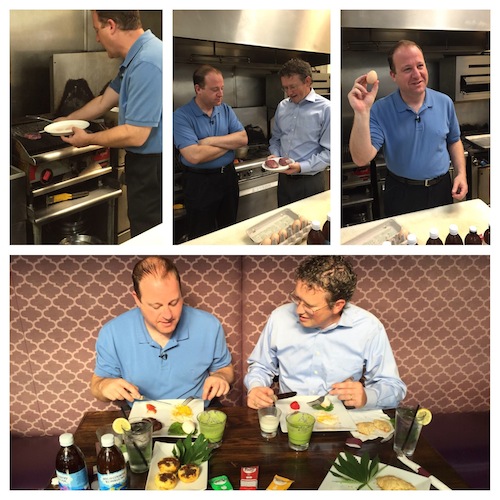
Yesterday morning, Congressman Thomas Massie and I met up in Colorado and cooked something we dubbed "The Forbidden Meal." We dined on hemp scones, raw milk, kombucha, farm eggs, and two cuts of beef raised by Rep. Massie himself...all to raise awareness about food freedom issues and the sometimes archaic and nonsensical federal regulations that govern our food and interfere with our freedom.
For example, the fact that hemp can't be grown or produced in the US under federal law (despite some states like CO and KY allowing it); or the fact that the ATF has threatened to require a local kombucha producer to sell under a liquor license (rotten kombucha ferments and could potentially reach .5% alcohol levels, about one eighth of a typical beer); or the fact that raw milk can't be transported across state lines, even between two states where it's legal to sell it; or the fact that meat from a "custom" inspection facility (like Rep. Massie uses) is restricted to personal, household, guest, and employee use, and can't be sold. Had I offered Rep. Massie $20 for the meal, we both could have been charged with a crime, and the USDA probably would have seized his refrigerator and cattle.
Individuals should have the freedom to make these choices on their own without government interference. Our Industrial Hemp Farming Act, Milk Freedom Act, and PRIME Act are common-sense measures that would do just that.
*****
PRIME Act Would Steer Meat Processing in the Right Direction
A great new bi-partisan House bill would wrest control over intrastate meat slaughter from the USDA.
Baylen Linnekin | August 1, 2015
Late last week, Rep. Thomas Massie (R-Ky.) introduced a bill that would dramatically re-shape the way many animals are slaughtered for food in this country. The PRIME Act, which has several co-sponsors, including Rep. Chellie Pingree (D-Maine) and Reps. Justin Amash (R-Mich.), John Garamendi (D-Calif.), Scott Garrett (R-N.J.), Jared Huffman (D-Calif.), and Jared Polis (D-Colo.), would give states the option of setting their own rules for processing meat that’s sold inside state borders.
So just what is the PRIME Act, and why do we need it? As Rep. Massie told me by phone this week, the bill is intended “to enable local farmers to sell their products to local consumers without all of the red tape and expense [posed by] the federal government.”
In place of that red tape, the simply worded, three-page PRIME Act would let states set their own standards.
*****
To track the status of this bill, and read it in its entirety, click here:
www.govtrack.us/congress/bills/114/hr3187
H.R. 3187: PRIME Act
Introduced: Jul 23, 2015
Status: Referred to Committee on Jul 23, 2015
This bill was assigned to a congressional committee on July 23, 2015, which will consider it before possibly sending it on to the House or Senate as a whole.
*****
Press Release:U.S. Representatives Massie and Pingree Introduce Bill to Revive Local Meat Processing
For Immediate Release This email address is being protected from spambots. You need JavaScript enabled to view it.
Thursday July 23, 2015 (202) 225-3465
Washington, D.C. - Today, U.S. Representatives Thomas Massie and Chellie Pingree (D-ME) introduced legislation to make it easier for small farms and ranches to serve consumers. The PRIME (Processing Revival and Intrastate Meat Exemption) Act would give individual states freedom to permit intrastate distribution of custom-slaughtered meat such as beef, pork, or lamb, to consumers, restaurants, hotels, boarding houses, and grocery stores.
“As a producer of grass-fed beef, I am familiar with the difficulties small producers face when marketing directly to consumers,” said Rep. Massie, who owns 50 head of cattle. “Despite consumers’ desire to know where their food comes from, federal inspection requirements make it difficult for them to purchase food from local farmers they know and trust. These onerous federal rules also make it more difficult for small farms and ranches to succeed financially. It is time to open our markets to small farms and producers and give consumers the freedom to choose.”
"More and more people want locally produced food, but because of the way the system is set up for processing meat, farmers and ranchers sometimes end up sending their animals hundreds or even thousands of miles to a giant slaughterhouse,” said Rep. Pingree, who raises grass-fed beef at her island farm in Maine and is the lead Democratic sponsor for the legislation. "That is just crazy and defeats the whole point of locally produced food. If we can change the federal regulations a little to make it easier to process meat locally, it's going to help farmers scale up and give local consumers what they want."
“The PRIME Act is the first step to rebuilding local processing infrastructure, which can revive rural economies and enable communities to become more self-sufficient in meat production,” stated Pete Kennedy, president of the Farm-to-Consumer Legal Defense Fund. “We applaud Representative Massie and Representative Pingree for taking on one of the bigger obstacles to a prosperous local food system.”
"Regulating sales of locally produced and sold meat at the state level has the potential to address a significant barrier to the growth of the local food system,” said Judith McGeary, Founder and Executive Director of Farm & Ranch Freedom Alliance. "As an organization that represents both farmers and consumers, the Farm and Ranch Freedom Alliance applauds this common-sense bill."
Current law exempts custom slaughter of animals from federal inspection regulations, but only if the meat is slaughtered for personal, household, guest, and employee use (21 U.S.C. § 623(a)). This means that in order to sell individual cuts of locally-raised meats to consumers, farmers and ranchers must first send their animals to one of a limited number of USDA-inspected slaughterhouses. These slaughterhouses are sometimes hundreds of miles away, which adds substantial transportation cost, and also increases the chance that meat raised locally will be co-mingled with industrially-produced meat. The PRIME Act would expand the current custom exemption and allow small farms, ranches, and slaughterhouses to thrive.
The PRIME Act (H.R. 3187), which is supported by the Farm-to-Consumer Legal Defense Fund and Farm & Ranch Freedom Alliance, is part of a series of “Food & Farm Freedom” initiatives championed by Massie, including The Industrial Hemp Farming Act of 2015 (H.R. 525), the Milk Freedom Act of 2014 (H.R. 4307 in the 113th Congress), and the Interstate Milk Freedom Act of 2014 (H.R. 4308 in the 113th Congress). Rep. Pingree was the lead Democratic co-sponsor on both “Milk Freedom” bills. Rep. Massie has also been a staunch advocate for country-of-origin labeling of food.
Original co-sponsors of the PRIME Act include Reps Walter Jones (R-NC) and Jared Polis (D-CO).
"Now, more than ever, the illusions of division threaten our very existence. We all know the truth: more connects us than separates us. But in times of crisis the wise build bridges, while the foolish build barriers. We must find a way to look after one another as if we were one single tribe.” -King T'Challa, Black Panther
The truth is incontrovertible. Malice may attack it. ignorance may deride it, but in the end, there it is. ~Winston Churchill
Last edit: 23 Aug 2015 10:41 by ScienceChic.
Please Log in or Create an account to join the conversation.
- FredHayek
-
- Mountain Legend
-

Less
More
- Posts: 31354
- Thank you received: 181
23 Aug 2015 11:03 #2
by FredHayek
Thomas Sowell: There are no solutions, just trade-offs.
Replied by FredHayek on topic Jared Polis & Thomas Massie: Support Bill to Revive Local Meat Processing
I am a buyer for a small corporation and I try to buy domestically if they are competitive in pricing because I trust American product so much more than Asian. They just don't have the same levels of inspection and concerns about quality as the USA does. It really scares me to see TPA make offshore meat processing more viable and hidden! If you are going to be processing American chickens overseas, label them that way!
Thomas Sowell: There are no solutions, just trade-offs.
Please Log in or Create an account to join the conversation.
- Mountain-News-Events
-

- Mountain Legend
-
23 Aug 2015 12:52 #3
by Mountain-News-Events
My Mountain Town Community Calendar - filter events by Category, date, or keyword to easily find events of interest. Add your community, church, or non-profit event to the calendar yourself! Click here to access the submission form. Businesses: please contact us for more information on adding your events! Questions? Email
Community News, Events, and Calendar Forum - Check here for the latest happenings in our community and add your own!
Replied by Mountain-News-Events on topic Jared Polis & Thomas Massie: Support Bill to Revive Local Meat Processing
Congressmen want more food freedom, less regulation
Jonathan Gonzalez, 9NEWS at KUSA
7:30 p.m. MDT August 21, 2015
Jonathan Gonzalez, 9NEWS at KUSA
7:30 p.m. MDT August 21, 2015
DENVER -- If you want Rep. Jared Polis (D-Boulder) and Rep. Thomas Massie, a Republican from Kentucky to agree on something, all you have to do is put a steak in front of them -- but first, you have to make sure that steak was never inspected by the USDA.
Polis and Massie came together Friday to munch on steak and drink raw milk at Jezebel's restaurant in Denver. They're promoting a series of bills designed to lessen regulations and restrictions on certain foods, including beef, milk, kombucha and hemp.
One of the bills Rep. Polis and Rep. Massie are promoting is the PRIME Act. It would allow states to let non-USDA beef slaughter houses sell beef within state lines directly to consumers, restaurants, hotels and grocery stores, without the beef ever being inspected by the USDA.
"We think people should be able to go to a farmer's market, and if a farmer there raised cattle and wants to sell it, they should be able to," he said.
The other issue is milk. The congressmen are pushing the "Milk Freedom Act" and the "Milk Interstate Freedom Act." They believe raw milk, which can be legally sold in some form in 29 states (It's illegal to sell raw milk in Colorado and Kentucky), should be legal nationwide, arguing that it's healthier.
My Mountain Town Community Calendar - filter events by Category, date, or keyword to easily find events of interest. Add your community, church, or non-profit event to the calendar yourself! Click here to access the submission form. Businesses: please contact us for more information on adding your events! Questions? Email
Community News, Events, and Calendar Forum - Check here for the latest happenings in our community and add your own!
Please Log in or Create an account to join the conversation.
- Forum
- The Highway
- The Courthouse
- Jared Polis & Thomas Massie: Support Bill to Revive Local Meat Processing
Time to create page: 0.171 seconds
sponsors