
- Posts: 15753
- Thank you received: 320
What the COVID-19 Pandemic Has in Common with Climate Change
- ScienceChic
-
 Topic Author
- Mountain Champion
-

Less
More
23 Apr 2020 08:28 #1
by ScienceChic
"Now, more than ever, the illusions of division threaten our very existence. We all know the truth: more connects us than separates us. But in times of crisis the wise build bridges, while the foolish build barriers. We must find a way to look after one another as if we were one single tribe.” -King T'Challa, Black Panther
The truth is incontrovertible. Malice may attack it. ignorance may deride it, but in the end, there it is. ~Winston Churchill
Like this pandemic, scientists and national security experts have been sounding the alarm for years that we needed to plan ahead and be prepared for the crisis that would someday come. We are now here, at 840,000+ confirmed cases and over 46,000 deaths, and climbing, which could've been prevented had we acted more swiftly and been better prepared.
Virulent disease outbreaks aren't sexy for politicians to talk about or consider funding. It's putting away money and resources for a rainy day, which the majority of people are notoriously bad at doing, and it doesn't make money (in the short term), it costs money. For the public, out of sight, out of mind. But as we are finding, once the crisis arrives, trying to catch up, being reactive rather than proactive, is far more harmful and devastating in terms of economic cost and precious loss of life.
Now let's do climate change. It's the same. damn. thing. If we learn any lesson from this pandemic, it's that we have to look at the big picture and to the future, and how our actions today, or inactions, will come back to bite us in the ass in a far more painful way if we fail to heed the warnings that scientists have been increasingly sounding for decades and take action to mitigate the worst of the damage.
I get it, it's hard to understand the danger when you don't see it affecting you directly and viscerally (much like viruses mutating in the wild, and and infecting hosts over and over until that perfect convergence finally happens of the right range of infectiousness and lethality that it can take off). Climate change is a slow beast, it has been building silently throughout the environmental system, giving us only glimpses of the devastation to come in stronger hurricanes and wildfire seasons, alarming extinction of plant and animal species around the world, and hints of collapses of food and water sources. If we had started cutting back greenhouse emissions ten, even five years ago, we could've done it much more gradually, with less effort and less cost required. We haven't so we're going to have to more aggressively ramp that up which will require more effort and more money.
Heed the scientists. Listen to the experts. Read the scientific reports, our military's conclusions on how this will become a national security threat, start taking your own measures to reduce carbon emissions and waste, and push your representatives to do more because this has to be done on a global scale. It's been 50 years since the first Earth Day, it's far past time that we make Earth Day every day and get back to protecting our home. It's the only one we've got.

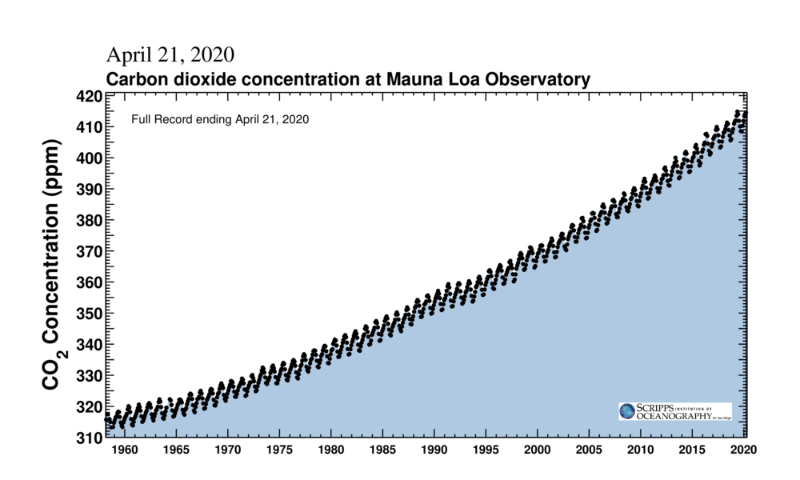
scripps.ucsd.edu/programs/keelingcurve/
Earth Day 2020 theme: Climate Action
Virulent disease outbreaks aren't sexy for politicians to talk about or consider funding. It's putting away money and resources for a rainy day, which the majority of people are notoriously bad at doing, and it doesn't make money (in the short term), it costs money. For the public, out of sight, out of mind. But as we are finding, once the crisis arrives, trying to catch up, being reactive rather than proactive, is far more harmful and devastating in terms of economic cost and precious loss of life.
Now let's do climate change. It's the same. damn. thing. If we learn any lesson from this pandemic, it's that we have to look at the big picture and to the future, and how our actions today, or inactions, will come back to bite us in the ass in a far more painful way if we fail to heed the warnings that scientists have been increasingly sounding for decades and take action to mitigate the worst of the damage.
I get it, it's hard to understand the danger when you don't see it affecting you directly and viscerally (much like viruses mutating in the wild, and and infecting hosts over and over until that perfect convergence finally happens of the right range of infectiousness and lethality that it can take off). Climate change is a slow beast, it has been building silently throughout the environmental system, giving us only glimpses of the devastation to come in stronger hurricanes and wildfire seasons, alarming extinction of plant and animal species around the world, and hints of collapses of food and water sources. If we had started cutting back greenhouse emissions ten, even five years ago, we could've done it much more gradually, with less effort and less cost required. We haven't so we're going to have to more aggressively ramp that up which will require more effort and more money.
Heed the scientists. Listen to the experts. Read the scientific reports, our military's conclusions on how this will become a national security threat, start taking your own measures to reduce carbon emissions and waste, and push your representatives to do more because this has to be done on a global scale. It's been 50 years since the first Earth Day, it's far past time that we make Earth Day every day and get back to protecting our home. It's the only one we've got.
scripps.ucsd.edu/programs/keelingcurve/
Earth Day 2020 theme: Climate Action
The first Earth Day in 1970 mobilized millions of Americans for the protection of the planet. On April 22, 1970, 20 million Americans — 10% of the U.S. population at the time — took to the street, college campuses, and hundreds of cities to protest environmental ignorance and demand a new way forward for our planet. The first Earth Day is credited with launching the modern environmental movement.
Earth Day is now recognized as the planet’s largest civic event and it led to passage of landmark environmental laws in the United States, including the Clean Air, Clear Water and Endangered Species Acts. Many countries soon adopted similar laws, and in 2016, United Nations chose Earth Day as the day to sign the Paris climate agreement into force.
“Despite that amazing success and decades of environmental progress, we find ourselves facing an even more dire, almost existential, set of global environmental challenges, from loss of biodiversity to climate change to plastic pollution, that call for action at all levels of government,” said Denis Hayes, the organizer of the first Earth Day in 1970 and Earth Day Network’s Board Chair Emeritus.
“Progress has slowed, climate change impacts grow, and our adversaries have become better financed,” said Earth Day Network president Kathleen Rogers. “We find ourselves today in a world facing global threats that demand a unified global response. For Earth Day 2020, we will build a new generation of environmentalist activists, engaging millions of people worldwide.”
"Now, more than ever, the illusions of division threaten our very existence. We all know the truth: more connects us than separates us. But in times of crisis the wise build bridges, while the foolish build barriers. We must find a way to look after one another as if we were one single tribe.” -King T'Challa, Black Panther
The truth is incontrovertible. Malice may attack it. ignorance may deride it, but in the end, there it is. ~Winston Churchill
Please Log in or Create an account to join the conversation.
- Pony Soldier
-

- User is blocked
-

Less
More
- Posts: 4749
- Thank you received: 43
23 Apr 2020 12:24 #2
by Pony Soldier
Replied by Pony Soldier on topic What the COVID-19 Pandemic Has in Common with Climate Change
Almost nobody is out driving. Industry is all but shut down worldwide and yet, the Carbon keeps climbing............kinda makes one wonder....
Please Log in or Create an account to join the conversation.
- FredHayek
-

- Mountain Legend
-

Less
More
- Posts: 31353
- Thank you received: 181
23 Apr 2020 13:17 #3
by FredHayek
Thomas Sowell: There are no solutions, just trade-offs.
Replied by FredHayek on topic What the COVID-19 Pandemic Has in Common with Climate Change
You are more hopeful than I am.
The US no longer makes long term commitments, the nation bounces from crisis to crisis. Congress no longer passes budgets, they just implement continuing resolutions. And now with probably 8 trillion to be spent on the pandemic, the money left to convert to high cost alternative energy isn't going to be a priority. With gas at less than $2 a gallon, that electric Prius might be more expensive to recharge than a gasoline powered Ford F-150.
The US no longer makes long term commitments, the nation bounces from crisis to crisis. Congress no longer passes budgets, they just implement continuing resolutions. And now with probably 8 trillion to be spent on the pandemic, the money left to convert to high cost alternative energy isn't going to be a priority. With gas at less than $2 a gallon, that electric Prius might be more expensive to recharge than a gasoline powered Ford F-150.
Thomas Sowell: There are no solutions, just trade-offs.
Please Log in or Create an account to join the conversation.
Time to create page: 0.164 seconds
sponsors