In case this hasn't been on your radar, it's becoming a critical issue and I highly recommend delving into the history and governance of water rights and usage. Any information you come across that pertains to this topic, please do add it here for future reference.
The dry 2020 and the lack of snow this season has water managers in seven states preparing for the first time for cutbacks outlined in drought contingency plans drafted two years ago.
A
sobering forecast released this week by the Bureau of Reclamation
shows the federally owned Lake Mead and Lake Powell — the nation’s two largest reservoirs and critical storage for Colorado River water and its 40 million users — dipping near-record-low levels. If those levels continue dropping as expected, long-negotiated agreements reached by the seven Colorado River Basin states in 2019 will go into effect, with water deliveries curtailed to prevent the federal government from stepping in and making hard water cuts.
The Bureau of Reclamation’s quarterly report was dire, showing Lake Powell at 42% of capacity and downriver’s Lake Mead at 40% capacity. And there’s not much water coming.
Opinion: Why Colorado is losing the water war Colorado cooperates with other states to avoid a long, unpredictable Supreme Court battle. But if we cooperate and Arizona doesn’t, we may continue to lose.
Ed Millard, The Colorado Sun | 3:00 AM MST on Jan 24, 2021
The Colorado River is under stress today due to rising temperatures and declining streamflows, as described in a
Dec. 13 Colorado Sun opinion essay
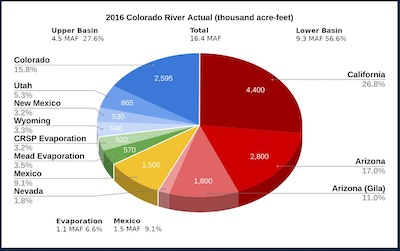
by Russell George and John Stulp. The other cause, seldom mentioned, is a water war among seven states, Mexico and the federal government — a war Colorado has been losing.
The
1922 Colorado River Compact
called for dividing the river’s water equally between the Upper Basin (Colorado, northwestern New Mexico, Utah, Wyoming and far northeastern Arizona) and the Lower Basin (California, Nevada, the rest of Arizona, southwestern Utah and western New Mexico). In the compact, each basin was promised 7.5 million acre-feet of water each year. (An acre-foot is 325,851 gallons, enough to cover an acre, about the size of a football field, 12 inches deep.)
At the last minute, Arizona demanded exclusive use of water from the Gila River, which flows from New Mexico across Arizona to the Colorado River at Yuma. In 1945, a treaty with Mexico further unbalanced the deal. There’s
more information here.
Without a doubt, 2020 has been hot and dry in Colorado. The entire state and its nearly 5.8 million residents are living in drought conditions as evidenced by the record-breaking fire season, low river flows and shrinking water supplies.
The next few months are predicted to be warmer and drier than normal, which will further reduce snowpack runoff into our reservoirs even with a normal snowpack this winter.
Unfortunately, 2020 is not an anomaly; rather, it is a harbinger of a future to which we must adapt.
"Now, more than ever, the illusions of division threaten our very existence. We all know the truth: more connects us than separates us. But in times of crisis the wise build bridges, while the foolish build barriers. We must find a way to look after one another as if we were one single tribe.” -King T'Challa, Black Panther
The truth is incontrovertible. Malice may attack it. ignorance may deride it, but in the end, there it is. ~Winston Churchill
I fear it is already too late for this year. We needed heavier snowfalls and lower temperatures in December and January. We can still get a lot of snow in Spring but it is much better to have the snow cover early keeping the soil and vegetation from drying out. Fingers crossed.
Thomas Sowell: There are no solutions, just trade-offs.