
- Posts: 10452
- Thank you received: 70
North Dakota
- Blazer Bob
-
 Topic Author
- Mountain Legend
-

Less
More
- Wayne Harrison
-

- Mountain Legend
-
Less
More
- Posts: 6722
- Thank you received: 72
12 Oct 2011 09:09 #2
by Wayne Harrison
Replied by Wayne Harrison on topic North Dakota
North Dakota has oil boom towns now, just like Alaska did in the 70s.
Please Log in or Create an account to join the conversation.
- FredHayek
-

- Mountain Legend
-
Less
More
- Posts: 31349
- Thank you received: 181
12 Oct 2011 09:20 #3
by FredHayek
Thomas Sowell: There are no solutions, just trade-offs.
Replied by FredHayek on topic North Dakota
One guy on NPR says his wages went from 30K to 90K in one year. Drill, baby, drill!
Thomas Sowell: There are no solutions, just trade-offs.
Please Log in or Create an account to join the conversation.
- The Viking
-

- Mountain Legend
-
Less
More
- Posts: 9276
- Thank you received: 31
12 Oct 2011 09:20 #4
by The Viking
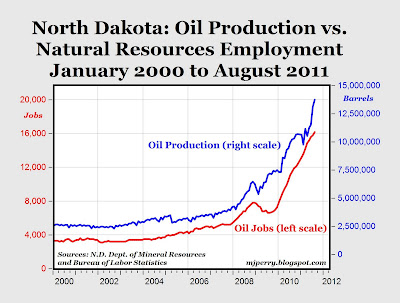
Great chart! Thanks. This is proof that we need to adapt the part of Perry's plan of becoming energy independent through making fossil fuels in the United States a main priority. They have said we have more here in the US than most of the Middle East combined but we have administrations that prefer bowing to environmentalists rather than employing Americans and turning this economy around. We need to use North Dakota as a blueprint for the rest of the nation. Their unemployment is under 4%. It will create hundreds of thousands if not millions of jobs in the US and will wean us off of the Middle Eastern control over us. Fuel costs will go down, durable goods prices will go down since it will not cost so much to transport. Exports and their profits will go up. Jobs will move back to the US due to lower costs and less regulations. It is a win/win all the way around. Perry spoke on it last night and he is right!
Replied by The Viking on topic North Dakota
neptunechimney wrote:
http://mjperry.blogspot.com/2011/10/eco ... akota.html
Great chart! Thanks. This is proof that we need to adapt the part of Perry's plan of becoming energy independent through making fossil fuels in the United States a main priority. They have said we have more here in the US than most of the Middle East combined but we have administrations that prefer bowing to environmentalists rather than employing Americans and turning this economy around. We need to use North Dakota as a blueprint for the rest of the nation. Their unemployment is under 4%. It will create hundreds of thousands if not millions of jobs in the US and will wean us off of the Middle Eastern control over us. Fuel costs will go down, durable goods prices will go down since it will not cost so much to transport. Exports and their profits will go up. Jobs will move back to the US due to lower costs and less regulations. It is a win/win all the way around. Perry spoke on it last night and he is right!
Please Log in or Create an account to join the conversation.
- The Viking
-
- Mountain Legend
-
Less
More
- Posts: 9276
- Thank you received: 31
12 Oct 2011 10:26 #5
by The Viking
Replied by The Viking on topic North Dakota
Wow, reality sure shuts up the left!
Please Log in or Create an account to join the conversation.
- ScienceChic
-

- Mountain Champion
-

Less
More
- Posts: 15753
- Thank you received: 320
12 Oct 2011 13:08 #6
by ScienceChic
 Of course oil jobs are going to go up as oil production increases, that's not surprising at all. What I question is the number of jobs claimed, especially in comparison to the number of jobs created in renewable energy fields - which is more beneficial for our economy? Plus, fossil fuels are not the energy of the future so why sink more money into a dying field? And did you read any of the comments in the OP?
http://www.sourcewatch.org/index.php?ti ... ted_States
Coal and jobs in the United States
http://www.skepticalscience.com/renewab ... s-jobs.htm
Renewable Energy Creates More Jobs than Fossil Fuels
"Now, more than ever, the illusions of division threaten our very existence. We all know the truth: more connects us than separates us. But in times of crisis the wise build bridges, while the foolish build barriers. We must find a way to look after one another as if we were one single tribe.” -King T'Challa, Black Panther
The truth is incontrovertible. Malice may attack it. ignorance may deride it, but in the end, there it is. ~Winston Churchill
Replied by ScienceChic on topic North Dakota
Sorry Darling, I've been busy this morning!The Viking wrote: Wow, reality sure shuts up the left!
Of course oil jobs are going to go up as oil production increases, that's not surprising at all. What I question is the number of jobs claimed, especially in comparison to the number of jobs created in renewable energy fields - which is more beneficial for our economy? Plus, fossil fuels are not the energy of the future so why sink more money into a dying field? And did you read any of the comments in the OP?http://www.sourcewatch.org/index.php?ti ... ted_States
Coal and jobs in the United States
New coal plants and number of jobs
A 2011 Ochs Center for Metropolitan Studies report, "A Fraction of the Jobs" found that power companies have overestimated the number of jobs created by new coal-fired power plants. The analysis looked at the six largest new coal-fired power plants to come online between 2005 and 2009, and combed through each project’s initial proposals and job projection data, including public statements, published documents and other material. They then compared that data to actual employment — before, during and after construction — in the areas where the projects were built, relying chiefly on the Bureau of Labor Statistics’ Quarterly Census of Employment and Wages.[20]
They found that only a little over half - or 56 percent - of every 1,000 jobs projected, appeared to be actually created as a result of the coal plants’ coming online. In four of the six counties, the projects delivered on just over a quarter of the jobs projected. Only one county, the Walter Scott unit number 4 project in Pottawattamie County, Iowa, saw an increase in construction employment that was roughly commensurate with the numbers predicted before the project there got under way.[20]
Coal regulations and jobs
Some companies argue that coal regulations would affect jobs in the power industry and slow overall economic growth. A June 2011 study by the Economic Policy Institute (EPI), "A lifesaver, not a job killer: EPA's proposed "air toxics rule" is no threat to job growth" found that new regulations on mercury, arsenic and other toxic air pollution from power plants proposed by the Environmental Protection Agency (EPA) in March 2011 would actually have a slightly positive impact on job growth and economic health.
The study found that:
The toxics rule would have a modest positive net impact on overall employment, likely leading to the creation of 28,000 to 158,000 jobs between now and 2015. (This estimate reflects the specific findings that follow below.)
The employment effect of the toxics rule on the utility industry itself could range from 17,000 jobs lost to 35,000 jobs gained.
The toxics rule would create between 81,000 and 101,000 jobs in the pollution abatement and control industry (which includes suppliers such as steelmakers).
Between 31,000 and 46,000 jobs would be lost due to higher energy prices leading to reductions in output.
Assuming a re-spending multiplier of 0.5, and since the net impact of the above impacts is positive, another 9,000 to 53,000 jobs would be created through re-spending.
http://www.skepticalscience.com/renewab ... s-jobs.htm
Renewable Energy Creates More Jobs than Fossil Fuels
Calzada's argument is also directly contradicted by reality, because renewable energy investment and development tends to create more jobs than fossil fuel energy because a larger share of renewable energy expenditures go to manufacturing equipment, installation, and maintenance, all of which are typically
more labor-intensive than extracting and transporting fossil fuels.
Indeed a 2004 UC Berkeley study concluded:
"Across a broad range of scenarios, the renewable energy sector generates more jobs than the fossil fuel-based energy sector per unit of energy delivered (i.e., per average megawatt)."
The study found that implementing a Renewable Portfolio Standard and investing in various types of renewable energy would create approximately twice as many jobs in the USA by 2020 as investing in coal and natural gas. Similarly, a 2001 Renewable Energy Policy Project report found that wind and solar photovoltaic investments lead to at least 40% more jobs per dollar than coal.
It's a complicated comparison, because renewable energy sources tend to be more expensive than fossil fuel energy. Thus hypothetically, the extra money invested in renewable energy could have been spent elsewhere to create new jobs in a different sector of the economy. However, fossil fuel energy is also artificially cheap because its price does not account for various external costs like climate change and impacts on public health. When accounting for all factors, it's likely that renewable energy results in more jobs per dollar invested than fossil fuels.
"Now, more than ever, the illusions of division threaten our very existence. We all know the truth: more connects us than separates us. But in times of crisis the wise build bridges, while the foolish build barriers. We must find a way to look after one another as if we were one single tribe.” -King T'Challa, Black Panther
The truth is incontrovertible. Malice may attack it. ignorance may deride it, but in the end, there it is. ~Winston Churchill
Please Log in or Create an account to join the conversation.
- HEARTLESS
-

- User is blocked
-

Less
More
- Posts: 4316
- Thank you received: 30
12 Oct 2011 13:17 #7
by HEARTLESS
The silent majority will be silent no more.
Replied by HEARTLESS on topic North Dakota
If all subsidies are dropped which energy field will create and sustain more jobs?
The silent majority will be silent no more.
Please Log in or Create an account to join the conversation.
- ScienceChic
-
- Mountain Champion
-
Less
More
- Posts: 15753
- Thank you received: 320
12 Oct 2011 13:29 #8
by ScienceChic
"Now, more than ever, the illusions of division threaten our very existence. We all know the truth: more connects us than separates us. But in times of crisis the wise build bridges, while the foolish build barriers. We must find a way to look after one another as if we were one single tribe.” -King T'Challa, Black Panther
The truth is incontrovertible. Malice may attack it. ignorance may deride it, but in the end, there it is. ~Winston Churchill
Replied by ScienceChic on topic North Dakota
Short-term: fossil fuel as the infrastructure is already in place. Long-term: renewable as it'll become cheaper. Unfortunately, the short-term pricing of fossil fuels doesn't factor in the price of environmental damage in the pipeline if continued, otherwise renewables would be cheaper from the get-go.
Edit to add: had we already been putting in renewables, at the pace that Germany had been doing, many of us would already have free electricity.
http://www.grist.org/solar-power/2011-1 ... now-all-of
Local solar could power the Mountain West right now, all of America in 2026
by John Farrell
9 Oct 2011

Edit to add: had we already been putting in renewables, at the pace that Germany had been doing, many of us would already have free electricity.
http://www.grist.org/solar-power/2011-1 ... now-all-of
Local solar could power the Mountain West right now, all of America in 2026
by John Farrell
9 Oct 2011
The Germans have installed over 10,000 megawatts of solar panels in the past two years, enough to power 2 million American homes (or most of Los Angeles, Calif.). If Americans installed local solar at the same torrid pace, we could already power most of the Mountain West, and could have a 100 percent solar nation by 2026, while enriching thousands of local communities with new development and jobs.

The spread of solar has also been in harmony with environmental goals. Rather than covering natural areas or fertile land with solar panels, 80 percent of the solar installed in Germany was on rooftops and built to a local scale (100 kilowatts or smaller -- the roof of a church or a Home Depot store).
The following map shows the amount of a state's electricity that could come from rooftop solar alone, from our 2009 report "Energy Self-Reliant States"
There's no way we can be a 100% solar nation, but we can add jobs and money to the economy - what is invested will pay for itself, unlike fossil fuels.Such local solar power also provides enormous economic benefits. For every megawatt of solar installed, as many as eight jobs are created. But the economic multiplier is significantly higher for locally owned projects, made possible when solar is built at a local scale as the Germans have done. With local ownership, making America a 100 percent solar nation could create nearly 10 million jobs, and add as much as $450 billion to the U.S. economy.
"Now, more than ever, the illusions of division threaten our very existence. We all know the truth: more connects us than separates us. But in times of crisis the wise build bridges, while the foolish build barriers. We must find a way to look after one another as if we were one single tribe.” -King T'Challa, Black Panther
The truth is incontrovertible. Malice may attack it. ignorance may deride it, but in the end, there it is. ~Winston Churchill
Please Log in or Create an account to join the conversation.
- HEARTLESS
-
- User is blocked
-
Less
More
- Posts: 4316
- Thank you received: 30
12 Oct 2011 13:49 #9
by HEARTLESS
The silent majority will be silent no more.
Replied by HEARTLESS on topic North Dakota
SC, here is the link to videos from Doctors for Disaster Preparedness conference. It has some one hour videos from Willie Soon, William Gray and Todd Shepherd that blow some big holes in the AGW myth.
http://www.ddponline.org/audio-video/
The first two question the cause and possible result of the global warming and the last shows the political BS of the Denver Museum of Natural History solar project (used by Obama to push for more money for solar). Again, I apologize for the length of the videos, but to think this argument is over is foolish.
The silent majority will be silent no more.
Please Log in or Create an account to join the conversation.
- Residenttroll returns
-

- Mountain Legend
-
Less
More
- Posts: 4630
- Thank you received: 0
12 Oct 2011 13:53 #10
by Residenttroll returns
Replied by Residenttroll returns on topic North Dakota
I just love the "maps" and "graphs" of the renewal energy industry....now, let's see an ROI calculation when compared to coal generated electricity.
Please Log in or Create an account to join the conversation.
Time to create page: 0.253 seconds
sponsors