- Posts: 13007
- Thank you received: 173
IMPERALISM ??? "IDEALLY A GOAL FOR THE POTUS''
- homeagain
-
 Topic Author
- Mountain Legend
-

Less
More
05 Jan 2026 14:14 #1
by homeagain
IMPERALISM ??? "IDEALLY A GOAL FOR THE POTUS'' was created by homeagain
Amber Phillips
By Amber Phillips
Much of what President Donald Trump is doing in Venezuela is politically risky and legally controversial. What happens next may determine if Americans view his actions as a successful intervention against a dangerous leader, or the start of a potentially unpopular nation-building exercise.
“I’m convinced there will be another strike,” said Mark Cancian, a military expert with the Center for Strategic and International Studies. “From there, how does this running Venezuela really work, and is the U.S. military going to still remain locked and loaded?”
Here are four major questions that legal and military experts are watching to understand what happens next.
1. Do U.S. troops go back into Venezuela?
Whether this was a one-off attack or the start of a sustained takeover of a foreign nation will largely depend on whether U.S. troops get involved again.
Trump isn’t ruling it out. The U.S. has already built up a massive operation in the waters off Venezuela, and it’s unclear how else it might “run” the country, as Trump has vowed to do. “We’re not afraid of boots on the ground,” he said, threatening military action if the remaining Venezuelan government doesn’t do what he directs.
A more sustained military presence in Venezuela would seem like a line that many Americans would rather not cross.
A Washington Post poll released Tuesday finds Americans are almost evenly split on the operation to remove Venezuela’s president. But there’s skepticism about what comes next, with 45 percent opposing the prospect of U.S. control in Venezuela, 24 percent in support and a significant 30 percent saying they are unsure.
Secretary of State Marco Rubio has downplayed the military’s role in Venezuela so far. “This was a very precise operation that involved a couple of hours of action,” Rubio said Sunday on NBC’s “Meet the Press.”
2. Does Congress try to stop Trump from more military action in Venezuela?
Some critics argue that Trump’s actions walk up to the line of illegality and urge Congress to act. The Constitution says only Congress can formally declare war — though it hasn’t done so since World War II. Congress can also tell a president not to engage in military action.
But Republicans control Congress, and in November the Senate voted down legislation that would have blocked Trump from attacking Venezuela.
The Senate is expected to vote again this week on a similar resolution. But senior Republican leaders in Congress haven’t pushed back on Trump’s reasons for escalating in Venezuela, which range from allegations that its leaders have been stealing U.S. oil to wanting to get an alleged drug trafficker out of office. The Trump administration has also been able to win over some of its Republican critics in the days after the attack.
Some Democrats say the Trump administration misled Congress about its plans to eventually attack Venezuela and seize its president. Some lawmakers on the left are talking about impeaching Trump on the issue, but that would almost certainly fail.
3. Does Trump invade other countries?
Greenland, Cuba, Colombia. Trump has suggested in recent days that all are potential targets of American aggression. “We do need Greenland, absolutely,” Trump told the Atlantic in reference to the Danish territory. He also predicted Cuba’s government would be the next to fall and threatened Colombia’s president.
He’s previously talked about annexing the Panama Canal, Gaza and making Canada the 51st state.
It’s not clear why Trump is so focused on expansion. The foreign policy experts I spoke to have theorized that the notion of imperialism appeals to Trump.
“It just seems to be back to the 18th and 19th centuries,” Fiona Hill, an expert at the Brookings Institution who was Trump’s top Russia adviser in FIrst term
IF U R NOT CONCERNED,THEN U HAVE NOT BEEN PAYING ATTENTION........''I AM KING OF EVERYTHING"..... SAYS THE 79 Y. O.GERIATRIC GUY
By Amber Phillips
Much of what President Donald Trump is doing in Venezuela is politically risky and legally controversial. What happens next may determine if Americans view his actions as a successful intervention against a dangerous leader, or the start of a potentially unpopular nation-building exercise.
“I’m convinced there will be another strike,” said Mark Cancian, a military expert with the Center for Strategic and International Studies. “From there, how does this running Venezuela really work, and is the U.S. military going to still remain locked and loaded?”
Here are four major questions that legal and military experts are watching to understand what happens next.
1. Do U.S. troops go back into Venezuela?
Whether this was a one-off attack or the start of a sustained takeover of a foreign nation will largely depend on whether U.S. troops get involved again.
Trump isn’t ruling it out. The U.S. has already built up a massive operation in the waters off Venezuela, and it’s unclear how else it might “run” the country, as Trump has vowed to do. “We’re not afraid of boots on the ground,” he said, threatening military action if the remaining Venezuelan government doesn’t do what he directs.
A more sustained military presence in Venezuela would seem like a line that many Americans would rather not cross.
A Washington Post poll released Tuesday finds Americans are almost evenly split on the operation to remove Venezuela’s president. But there’s skepticism about what comes next, with 45 percent opposing the prospect of U.S. control in Venezuela, 24 percent in support and a significant 30 percent saying they are unsure.
Secretary of State Marco Rubio has downplayed the military’s role in Venezuela so far. “This was a very precise operation that involved a couple of hours of action,” Rubio said Sunday on NBC’s “Meet the Press.”
2. Does Congress try to stop Trump from more military action in Venezuela?
Some critics argue that Trump’s actions walk up to the line of illegality and urge Congress to act. The Constitution says only Congress can formally declare war — though it hasn’t done so since World War II. Congress can also tell a president not to engage in military action.
But Republicans control Congress, and in November the Senate voted down legislation that would have blocked Trump from attacking Venezuela.
The Senate is expected to vote again this week on a similar resolution. But senior Republican leaders in Congress haven’t pushed back on Trump’s reasons for escalating in Venezuela, which range from allegations that its leaders have been stealing U.S. oil to wanting to get an alleged drug trafficker out of office. The Trump administration has also been able to win over some of its Republican critics in the days after the attack.
Some Democrats say the Trump administration misled Congress about its plans to eventually attack Venezuela and seize its president. Some lawmakers on the left are talking about impeaching Trump on the issue, but that would almost certainly fail.
3. Does Trump invade other countries?
Greenland, Cuba, Colombia. Trump has suggested in recent days that all are potential targets of American aggression. “We do need Greenland, absolutely,” Trump told the Atlantic in reference to the Danish territory. He also predicted Cuba’s government would be the next to fall and threatened Colombia’s president.
He’s previously talked about annexing the Panama Canal, Gaza and making Canada the 51st state.
It’s not clear why Trump is so focused on expansion. The foreign policy experts I spoke to have theorized that the notion of imperialism appeals to Trump.
“It just seems to be back to the 18th and 19th centuries,” Fiona Hill, an expert at the Brookings Institution who was Trump’s top Russia adviser in FIrst term
IF U R NOT CONCERNED,THEN U HAVE NOT BEEN PAYING ATTENTION........''I AM KING OF EVERYTHING"..... SAYS THE 79 Y. O.GERIATRIC GUY
Please Log in or Create an account to join the conversation.
- FredHayek
-
- Mountain Legend
-
Less
More
- Posts: 31347
- Thank you received: 181
05 Jan 2026 15:02 #2
by FredHayek
Thomas Sowell: There are no solutions, just trade-offs.
Replied by FredHayek on topic IMPERALISM ??? "IDEALLY A GOAL FOR THE POTUS''
19th Century? Try the 20th Century when the US seized Cuba, Puerto Rico, Guam, and the Philippines from Spain after one of our battleships had an accidental explosion.
Or WWII, when we seized Greenland from the Nazi puppet government of Denmark.
America has a long history of imperialism.
Or WWII, when we seized Greenland from the Nazi puppet government of Denmark.
America has a long history of imperialism.
Thomas Sowell: There are no solutions, just trade-offs.
Please Log in or Create an account to join the conversation.
- FredHayek
-
- Mountain Legend
-
Less
More
- Posts: 31347
- Thank you received: 181
05 Jan 2026 15:05 #3
by FredHayek
Thomas Sowell: There are no solutions, just trade-offs.
Replied by FredHayek on topic IMPERALISM ??? "IDEALLY A GOAL FOR THE POTUS''
Like your author, I am curious what Venezuela will become. Will we just let Maduro's underlings continue to run the country as long as they do what we want?
Probably the cheapest option.
Will we force the government to eventually hold free democratic elections? I have to imagine the many Venezuelan expatriates heading home want to see that.
Will the US appoint a puppet government and start arresting Maduros cronies and hold trials?
Probably the cheapest option.
Will we force the government to eventually hold free democratic elections? I have to imagine the many Venezuelan expatriates heading home want to see that.
Will the US appoint a puppet government and start arresting Maduros cronies and hold trials?
Thomas Sowell: There are no solutions, just trade-offs.
Please Log in or Create an account to join the conversation.
- Rick
-

- Mountain Legend
-
Less
More
- Posts: 15708
- Thank you received: 165
05 Jan 2026 15:27 #4
by Rick
The left is angry because they are now being judged by the content of their character and not by the color of their skin.
Replied by Rick on topic IMPERALISM ??? "IDEALLY A GOAL FOR THE POTUS''
Maduros cronies best leave the country or start new careers. The message is pretty clear that they have no viable protection.
The left is angry because they are now being judged by the content of their character and not by the color of their skin.
Please Log in or Create an account to join the conversation.
- PrintSmith
-

- Mountain Legend
-
Less
More
- Posts: 5795
- Thank you received: 40
05 Jan 2026 18:01 - 05 Jan 2026 18:02 #5
by PrintSmith
Replied by PrintSmith on topic IMPERALISM ??? "IDEALLY A GOAL FOR THE POTUS''
Trump didn't "attack" Venezuela . . . the mission had one focus, to secure the drug overlord who was operating a narco-terrorist state and remove him to the United States to stand trial for his offenses. It was an arrest warrant served by US Special Forces in cooperation with US federal law enforcement agencies. With El Chapo, the Mexican government extradited the man to face US justice. Given Maduro was the ruling dictator in Venezuela, it wasn't likely that the Venezuelan government was going to extradite him to the US, so we extracted him ourselves.
Obama issued an executive order declaring an emergency over Maduro's regime and barring any immigration from Venezuela. The Trump 45 administration issued a bounty of $15 million for information leading to his capture and arrest. Biden's administration upped the ante to $25 million mere days before leaving office, and Trump 47 doubled it to $50 million for information leading to the capture and arrest of Maduro. The man had been a fugitive from US justice for well over a decade now.
This was, essentially, a high-tech SWAT raid on Maduro's residence to capture and arrest an indicted criminal and bring them before a US criminal court to face charges. There are over 60 nations that fail to recognize Maduro and his minions as the legitimately elected government of Venezuela. The situation is little different from when the US went into Panama to arrest Noriega.
Companies here in the US have judgements from an international court seeking compensation for damages that Venezuela refuses to pay. When they "socialized" the assets of US companies, including the oil recovered using technology and equipment purchased and installed by US companies in line with the contracts Venezuela had entered into, it was not in any way materially different than someone committing an armed robbery after signing a contract to provide security for the business.
There's no "US invasion" of Venezuela happening here. Why seek to proclaim a falsity instead of the simple facts of the matter other than another opportunity to give voice to one's TDS? Trump doesn't need the approval of Congress for what is essentially a law enforcement operation. Posse Comitatus doesn't apply, this wasn't a domestic law enforcement operation, it was an international US law enforcement operation involving federal armed services members.
Obama issued an executive order declaring an emergency over Maduro's regime and barring any immigration from Venezuela. The Trump 45 administration issued a bounty of $15 million for information leading to his capture and arrest. Biden's administration upped the ante to $25 million mere days before leaving office, and Trump 47 doubled it to $50 million for information leading to the capture and arrest of Maduro. The man had been a fugitive from US justice for well over a decade now.
This was, essentially, a high-tech SWAT raid on Maduro's residence to capture and arrest an indicted criminal and bring them before a US criminal court to face charges. There are over 60 nations that fail to recognize Maduro and his minions as the legitimately elected government of Venezuela. The situation is little different from when the US went into Panama to arrest Noriega.
Companies here in the US have judgements from an international court seeking compensation for damages that Venezuela refuses to pay. When they "socialized" the assets of US companies, including the oil recovered using technology and equipment purchased and installed by US companies in line with the contracts Venezuela had entered into, it was not in any way materially different than someone committing an armed robbery after signing a contract to provide security for the business.
There's no "US invasion" of Venezuela happening here. Why seek to proclaim a falsity instead of the simple facts of the matter other than another opportunity to give voice to one's TDS? Trump doesn't need the approval of Congress for what is essentially a law enforcement operation. Posse Comitatus doesn't apply, this wasn't a domestic law enforcement operation, it was an international US law enforcement operation involving federal armed services members.
Last edit: 05 Jan 2026 18:02 by PrintSmith.
Please Log in or Create an account to join the conversation.
- FredHayek
-
- Mountain Legend
-
Less
More
- Posts: 31347
- Thank you received: 181
05 Jan 2026 18:40 #6
by FredHayek
Thomas Sowell: There are no solutions, just trade-offs.
Replied by FredHayek on topic IMPERALISM ??? "IDEALLY A GOAL FOR THE POTUS''
Democrats are such hypocrites. In Trump's first term, they claim The Don was best friends with Maduro. He captures Maduro and the Left gets all upset.
Thomas Sowell: There are no solutions, just trade-offs.
Please Log in or Create an account to join the conversation.
- homeagain
-
Topic Author
- Mountain Legend
-
Less
More
- Posts: 13007
- Thank you received: 173
06 Jan 2026 12:33 - 06 Jan 2026 12:35 #7
by homeagain
Replied by homeagain on topic IMPERALISM ??? "IDEALLY A GOAL FOR THE POTUS''
'BOOTS ON THE GROUND CAN NOT BE RULED OUT AND WHEN THE STATEMENT IS MADE 'WE WILL RUN THE COUNTRY'........IT IS NOT AN INVASION????? PLEASE TELL ME U R NOT THAT NAIVE.....OIL IS THE OBJECT AND PROCURING THIS SOURCE IS PARAMOUNT....LET'S BE HONEST OK?
here's no "US invasion" of Venezuela happening here. PER PS.....REALLY???
here's no "US invasion" of Venezuela happening here. PER PS.....REALLY???
Last edit: 06 Jan 2026 12:35 by homeagain. Reason: ADD
Please Log in or Create an account to join the conversation.
- FredHayek
-
- Mountain Legend
-
Less
More
- Posts: 31347
- Thank you received: 181
06 Jan 2026 13:06 #8
by FredHayek
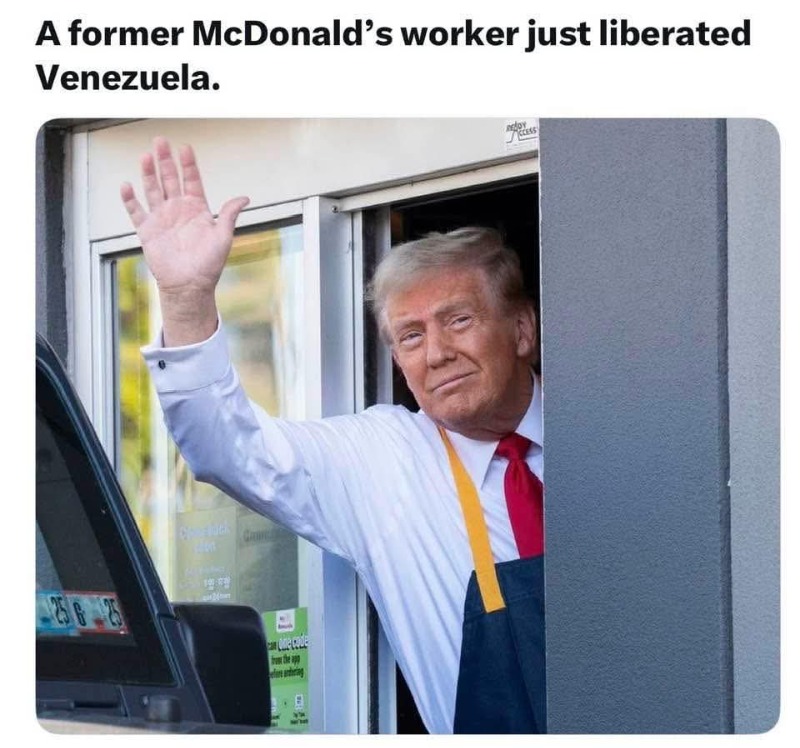




Trump's best buddies are domestic oil producers. Why would he want to upset them with imports of cheap Petroleum that Lower both oil and gasoline prices?
But cutting off China, Cuba, and other totalitarian governments from low cost Venezuelan oil will destroy their economies. Expect it to take some time for Chevron and others to upgrade facilities in Venezuela.
Thomas Sowell: There are no solutions, just trade-offs.
Replied by FredHayek on topic IMPERALISM ??? "IDEALLY A GOAL FOR THE POTUS''
Trump's best buddies are domestic oil producers. Why would he want to upset them with imports of cheap Petroleum that Lower both oil and gasoline prices?
But cutting off China, Cuba, and other totalitarian governments from low cost Venezuelan oil will destroy their economies. Expect it to take some time for Chevron and others to upgrade facilities in Venezuela.
Thomas Sowell: There are no solutions, just trade-offs.
Please Log in or Create an account to join the conversation.
- PrintSmith
-
- Mountain Legend
-
Less
More
- Posts: 5795
- Thank you received: 40
07 Jan 2026 15:50 - 07 Jan 2026 15:52 #9
by PrintSmith
Yes, we are operating a blockade that prohibits sanctioned oil from being shipped to other areas, but that is all that is being swept up in that blockade net . . . sanctioned tankers carrying Venezuelan oil, another law enforcement action.
Why do you insist on pretending that only the US considers Maduro's dictatorship to be an illegitimate government when the fact of the matter is we are on of over 60 countries that hold this belief? Why do you insist on pretending that this is a new position under the current Trump administration when the truth of the matter is that the US government has held that same position for over a decade across multiple administrations?
There was no invasion of Venezuela, it was a high-tech SWAT operation employing federal troops to serve an arrest warrant issued after an indictment was secured in complete compliance with all of the due process guarantees protected by the federal Constitution; nothing more, nothing less.
Foreign influence in the Americas is considered to be a threat to our national security and has been considered as such for the last 200 years. Our current president is an advocate of that long standing position and he also has the will to ensure the actions of these United States are in support of that position. Among Trump's notable predecessors who also held that view are FDR, JFK, Reagan, and Teddy Roosevelt. Not really bad company to be in . . .
Replied by PrintSmith on topic IMPERALISM ??? "IDEALLY A GOAL FOR THE POTUS''
Yes, really. Is the US military occupying any sovereign Venezuela territory in that wake of that arrest warrant being served HA? You and I both know the answer is no.homeagain wrote: 'BOOTS ON THE GROUND CAN NOT BE RULED OUT AND WHEN THE STATEMENT IS MADE 'WE WILL RUN THE COUNTRY'........IT IS NOT AN INVASION????? PLEASE TELL ME U R NOT THAT NAIVE.....OIL IS THE OBJECT AND PROCURING THIS SOURCE IS PARAMOUNT....LET'S BE HONEST OK?
here's no "US invasion" of Venezuela happening here. PER PS.....REALLY???
Yes, we are operating a blockade that prohibits sanctioned oil from being shipped to other areas, but that is all that is being swept up in that blockade net . . . sanctioned tankers carrying Venezuelan oil, another law enforcement action.
Why do you insist on pretending that only the US considers Maduro's dictatorship to be an illegitimate government when the fact of the matter is we are on of over 60 countries that hold this belief? Why do you insist on pretending that this is a new position under the current Trump administration when the truth of the matter is that the US government has held that same position for over a decade across multiple administrations?
There was no invasion of Venezuela, it was a high-tech SWAT operation employing federal troops to serve an arrest warrant issued after an indictment was secured in complete compliance with all of the due process guarantees protected by the federal Constitution; nothing more, nothing less.
Foreign influence in the Americas is considered to be a threat to our national security and has been considered as such for the last 200 years. Our current president is an advocate of that long standing position and he also has the will to ensure the actions of these United States are in support of that position. Among Trump's notable predecessors who also held that view are FDR, JFK, Reagan, and Teddy Roosevelt. Not really bad company to be in . . .
Last edit: 07 Jan 2026 15:52 by PrintSmith.
Please Log in or Create an account to join the conversation.
- FredHayek
-
- Mountain Legend
-
Less
More
- Posts: 31347
- Thank you received: 181
07 Jan 2026 16:53 #10
by FredHayek
Thomas Sowell: There are no solutions, just trade-offs.
Replied by FredHayek on topic IMPERALISM ??? "IDEALLY A GOAL FOR THE POTUS''
Currently US ground troops are not occupying Venezuela. Maduro's former minions still control Caracas.
I think as long as they don't piss off Rubio and Trump they will continue in power. What happens to the Nobel Prize Award winner? Will she eventually rule? Or the candidate that won the last tainted election that Maduro stole?
Lots of questions still to be answered.
I think as long as they don't piss off Rubio and Trump they will continue in power. What happens to the Nobel Prize Award winner? Will she eventually rule? Or the candidate that won the last tainted election that Maduro stole?
Lots of questions still to be answered.
Thomas Sowell: There are no solutions, just trade-offs.
Please Log in or Create an account to join the conversation.
Time to create page: 0.201 seconds
sponsors